
Table of Contents
- What Counts as a Boutique Retailer (And What Doesn't)
- Boutique vs Big Box Store Quality: What Actually Differs
- Personalized Customer Service in Retail: More Than a Smile
- Why Shop Small Business: The Local Economy Effect
- Curated Selection and Exclusive Access You Won't Find Elsewhere
- The Boutique vs Online Marketplace Trade-Off
- Frequently Asked Questions
Last Updated: September 13, 2026
What Counts as a Boutique Retailer (And What Doesn't)
Boutique retailers are independent shops with a small, deliberately chosen range and owner-level attention, defined by curation and accountability, not size or aesthetic.
A store can have exposed brick and one rack of jackets and still be a reseller moving pallet goods with no selection logic. At 4GodsYourGlory, we offer a curated selection of lifestyle and apparel products designed to meet your daily needs.
Three Signs You're Dealing With a True Boutique
Use these three checks before you spend:
- The owner can name the maker. Ask who produced an item and why it was stocked. A real boutique answers without hesitation; a reseller deflects to the label.
- The range is narrow on purpose. A curated collection means some categories are missing entirely. If a shop carries everything, it curates nothing.
- Staff know the inventory, not just the promotion. They can tell you how a fabric wears, how a size runs, and what to pair it with.
Boutique vs Big Box Store Quality: What Actually Differs
Big box stores buy in volume, and volume buying rewards standardization: one supplier, one specification, one cost target across thousands of units. That delivers consistency and low prices, rarely distinctiveness.
The boutique versus big box store quality gap is not automatically about better materials. It is about selection pressure: a small shop stakes its reputation on a handful of products, so one bad batch hurts, while a large chain absorbs a weak line and moves on.
Not every boutique item outperforms every big box item: boutiques win on consistency of intent, not a universal quality guarantee.
Materials, Construction, and the Value Per Wear Math
Value per wear is price divided by the number of times you wear it. A $70 jacket worn 100 times costs $0.70 per wear; a $30 jacket worn eight times before the zipper fails costs $3.75 per wear, more than five times as expensive.
This is where construction details earn their keep:
- Reinforced stitching at stress points extends usable life
- Hardware quality (zippers, closures, eyelets) usually fails before fabric does
- Fabric weight and coating determine whether an item survives a season or five
A practical example from our own catalog: the Water-Resistant Lightweight Zip-Up with Hood uses 100% polyester with an interior water-resistant coating rated to 600 mm, matte-finish eyelets, and a #4 zipper with a rubber pull tab. Those components decide whether a jacket lasts three winters or one, value per wear only works when the hardware holds.

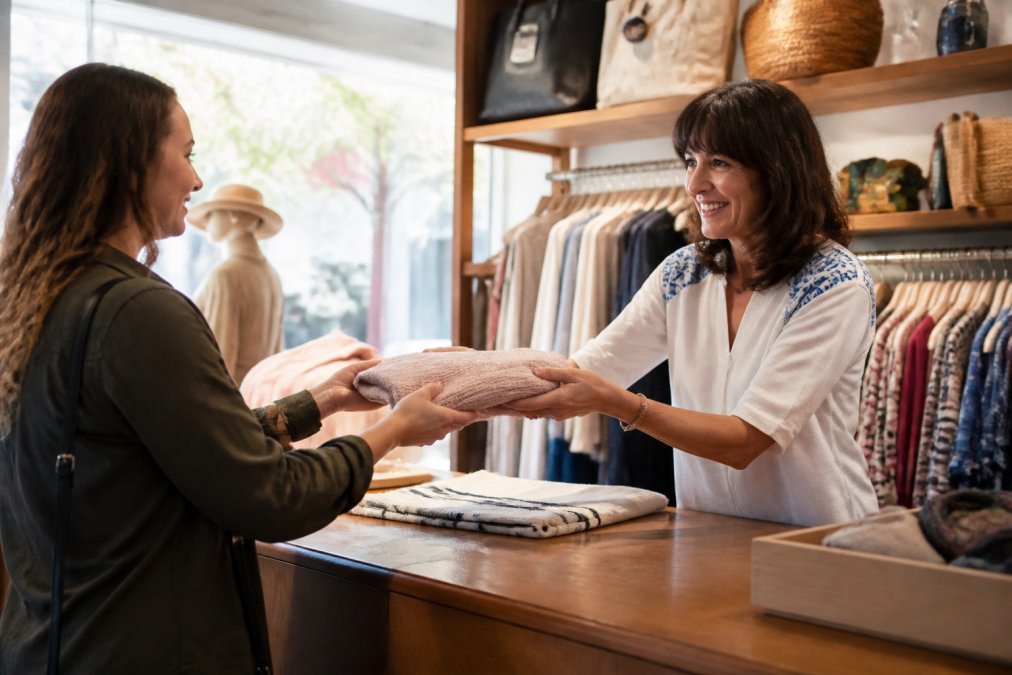
Personalized Customer Service in Retail: More Than a Smile
Why Shop Small Business: The Local Economy Effect
Ownership. At a national chain, profit flows to shareholders and a corporate treasury, and the store manager is a salaried employee with limited discretion. At an independent shop, the owner is often behind the counter, profit stays with a household in the same tax base, and that owner tends to spend locally, on a local accountant, landlord, or sign maker.
Banking. Small retailers disproportionately bank with community banks and credit unions, which lend to local small businesses and mortgages at higher rates than national banks (FDIC Issues 2024 Small Business Lending Survey Report). Spend at a chain and the deposit relationship usually sits with a large institution lending across a national portfolio. The multiplier effect depends on where the deposit lands.
Sourcing. A boutique stocking from regional makers keeps more of the supply chain within a few hundred miles; a chain sourcing from overseas contract factories sends the manufacturing margin abroad (Make Onshoring Great Again portal). Neither is inherently wrong, but they produce different local outcomes.
What the Local Effect Actually Looks Like in Practice
The Trade-Off You Should Acknowledge
Curated Selection and Exclusive Access You Won't Find Elsewhere
Exclusive access is the most concrete benefit of buying from boutique retailers, because a small shop can stock items a national chain never will. Limited-edition runs, niche-market products, and short production batches all fail the volume test big retailers apply (census.gov). But "curated" has become a marketing word, so here is the mechanism and the checklist.
How Curation Actually Works
How to Tell a True Boutique from a 'Boutique-Style' Mass Retailer
Many chains and online sellers use boutique aesthetics, exposed brick, handwritten signage, minimal photography, while operating on a mass-retail model. Use this checklist:
- Can the staff name the maker? Ask who produced a specific item. A true boutique answers without hesitation. A reseller deflects to the label or the distributor.
- Is the range narrow on purpose? A curated collection means some categories are missing entirely. If a shop carries everything, it curates nothing.
- Can you ask what they chose not to carry? Genuine boutiques have a ready answer. Resellers have never thought about it.
- Is the inventory depth shallow? Boutiques often carry one or two units per size. Mass retailers carry deep stock in every size.
- Does the same item appear on a marketplace at a lower price? If so, the shop is likely reselling rather than curating.
- Is there a named owner or buyer? A real boutique has a person accountable for the selection. A boutique-style chain has a merchandising department.
Why Exclusive Access Is Real, Not Marketing
The Boutique vs Online Marketplace Trade-Off
Convenience and curation pull in opposite directions. An online marketplace offers unlimited selection, aggressive pricing, and fast shipping, but no filtering, no accountability for quality, and no one to ask when a product disappoints.
Here is how the two models compare on the factors that decide whether you're satisfied six months later:
| Factor | Boutique Retailer | Online Marketplace |
|---|---|---|
| Selection | Curated, limited | Unlimited, unfiltered |
| Product guidance | Staff with product knowledge | Reviews and spec sheets |
| Quality control | Buyer-vetted inventory | Seller-declared |
| Pricing | Higher upfront, better value per wear | Lowest upfront |
| After-sales support | Direct, named contact | Platform-mediated, varies |
| Environmental footprint | Smaller batches, less overproduction | Higher returns and packaging waste |
After-Sales Support, Warranty Nuances, and Environmental Footprint
At 4GodsYourGlory, we keep product descriptions specific, listing materials, sizing, and construction details up front. See it on our Christian Reflective Cap, where panel count, closure type, and profile are stated rather than implied.

Our catalog pairs a focused selection of footwear with practical everyday gear, including the Christian Safety Vest for high-visibility work and the 40oz Insulated Travel Mug for long commutes. Every listing states materials, sizing, and construction details so you know what arrives.

Add to your collection with 4GodsYourGlory.
Frequently Asked Questions
Are boutique items actually higher quality than mass-produced goods?
Quality varies by retailer. Check construction details like stitching density, hardware weight, and fabric feel before assuming a higher price equals higher quality.
How does shopping at a boutique support the local economy?
Independent retailers recirculate a larger share of revenue back into their communities through local wages, rent, and supplier relationships than national chains do. When you buy from a small retailer, that money stays closer to home and supports economic growth at the neighborhood level. You also build a retailer relationship that can lead to personalized styling advice, early access to new arrivals, and after-sales support you won't get from a warehouse operation.
What makes a boutique different from a regular store?
A boutique carries a curated collection rather than everything a category can hold. The inventory reflects a specific point of view. A regular big box store competes on volume and price; a boutique competes on selection and customer experience.
Are boutique clothes worth the higher price point?
It depends on how you measure value. If you calculate value per wear, a well-made piece that lasts three years and fits properly often costs less per use than a cheaper item you replace twice. For basics you'll wear weekly, like a quality cap or a water-resistant jacket, the long-term value tends to justify the upfront cost.