
Table of Contents
- Custom Fit vs. Universal Car Sun Shades: What's the Real Difference
- How to Measure Your Windshield for a Sun Shade
- UV Protection and Interior Heat Reduction: What Actually Works
-
Top Fitting Sun Shades for Cars Ranked by Performance
- 1. 4GodsYourGlory Auto Sun Shades: Best Budget Option
- 2. WeatherTech Custom Fit SunShade: Premium Precision
- 3. Covercraft UVS100 Custom Sunscreen: Maximum Heat Blocking
- 4. Intro-Tech Automotive Ultimate Reflector: Best All-Around Custom Fit
- 5. EcoNour Car Windshield Sun Shade: Best Quick-Deploy Universal
- Choosing a Custom Fit Windshield Sun Shade: Key Factors
- Material Durability, Storage, and Long-Term Wear
- ADAS Sensor Compatibility and Modern Vehicle Considerations
- Conclusion
Last Updated: August 10, 2026
Custom Fit vs. Universal Car Sun Shades: What's the Real Difference
Custom-fit shades deliver superior coverage and heat reduction because they're laser-cut to your windshield's exact dimensions, eliminating gaps that let UV rays and heat slip through. Universal shades prioritize speed and affordability over perfect fit.
Custom-fit options require your vehicle's year, make, and model and are laser-cut to match your windshield's exact contours, eliminating gaps and bunching. Universal shades use accordion or umbrella-style designs that adapt to different windshield sizes but typically leave quarter-inch gaps at corners where heat penetrates.
According to automotive interior care research from industry standards bodies, interior temperatures can reach 160°F on a 90°F day without proper sun protection. A properly fitted shade can reduce that by 30-40°F, with custom-fit shades consistently outperforming universal options due to complete windshield sealing.
Custom-fit shades typically last 5-7 years with proper storage, while universal shades show wear after 2-3 years because universal designs flex more during deployment, stressing the material.
How to Measure Your Windshield for a Sun Shade
Measuring your windshield correctly takes five minutes and requires only a flexible tape measure and notepad. You need the width at three points (top, middle, bottom) and the height at three points (left, left-center, right-center).
Start by measuring the windshield width at the very top where glass meets the roof line, then at the middle and bottom where glass meets the dashboard. These three measurements account for the slight curve most windshields have.
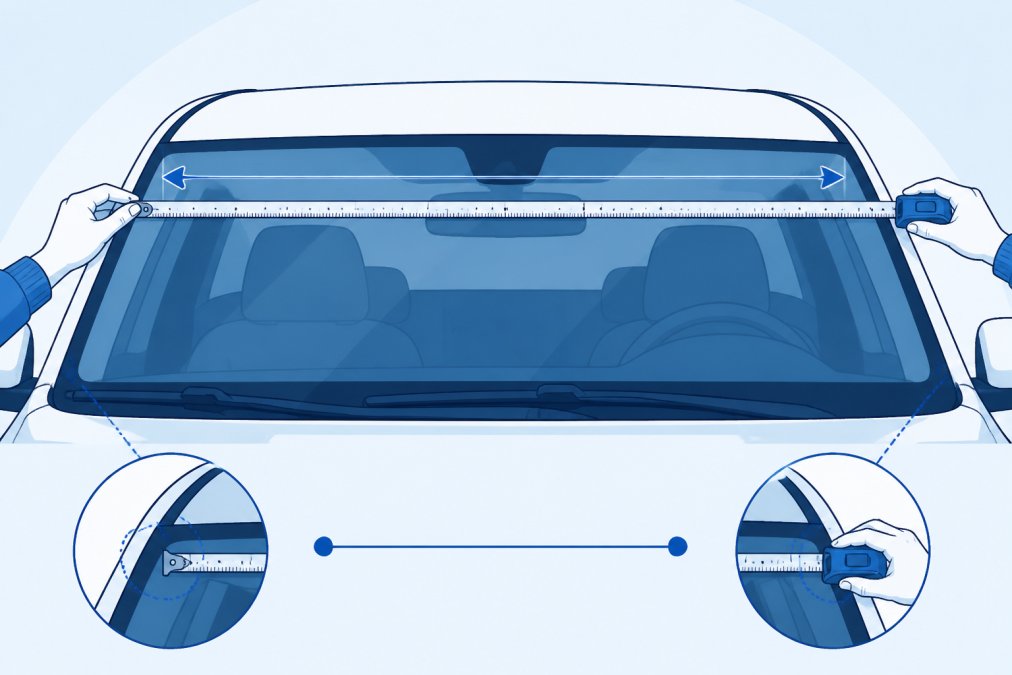
Next, measure the height from the top-left corner where glass meets the roof straight down to where glass ends at the dashboard. Repeat at the center and right side. Write down all six measurements clearly. Even within the same model year, variations exist between trim levels and production batches, so taking five minutes to measure prevents fit problems.
UV Protection and Interior Heat Reduction: What Actually Works
UV rays cause dashboard cracking and fading, while heat buildup damages steering wheels, seats, and paint. Quality shades address both simultaneously through different mechanisms.
Most premium shades use multi-layer construction with a reflective outer surface that bounces UV radiation away. The reflective coating, typically aluminum or metallized polymer, can reflect up to 99% of UV rays, significantly more effective than tinted windows, which block 50-70%.
Heat reduction works through reflection and insulation. The reflective outer layer bounces solar radiation away, while the foam or insulating core prevents heat transfer into the vehicle. Research from automotive thermal management studies shows properly deployed sun shades reduce interior temperature rise by 30-40 degrees Fahrenheit.

Budget universal shades use single-layer reflective material with minimal insulation. Premium custom-fit shades like Covercraft UVS100 use triple-layer construction with foam core specifically designed for maximum thermal insulation. Lower-quality reflective coatings degrade after 2-3 years of sun exposure, while premium shades maintain reflectivity for 5-7 years.
Top Fitting Sun Shades for Cars Ranked by Performance
1. 4GodsYourGlory Auto Sun Shades: Best Budget Option
4GodsYourGlory's auto sun shades deliver solid performance at $30.38. The double-insulated laminate material provides meaningful UV protection and heat reduction with a fold-for-storage design that eliminates bulky accordion mechanisms.
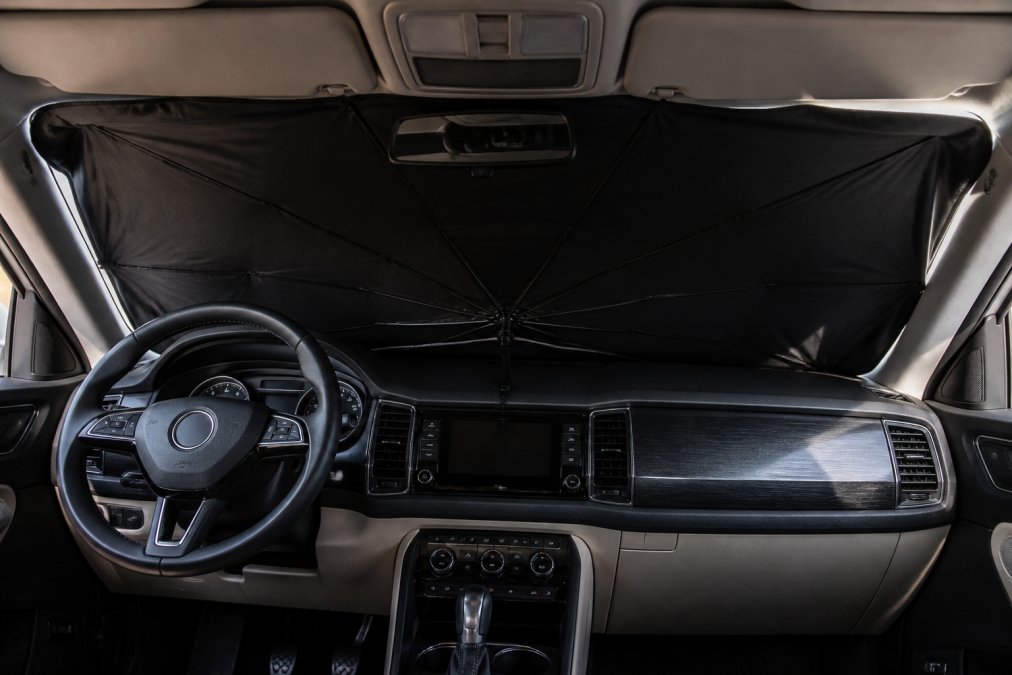
Installation is quick, under two minutes for most users. The shade blocks 70-80% of solar radiation, making a meaningful difference in interior temperature. The limitation is fitment precision, minor gaps appear at corners on some vehicles. The reflective coating may degrade after 3-4 years.
Pros:
- Lowest price among quality options
- Double-insulated material outperforms single-layer competitors
- Quick deployment and compact storage
- Effective UV protection for the price
Cons:
- Universal fit means minor gaps on some vehicles
- Not as durable long-term as premium custom-fit options
- Reflective coating may degrade after 3-4 years
2. WeatherTech Custom Fit SunShade: Premium Precision
WeatherTech's custom-fit design at $58.95 offers precision engineering and materials lasting 5-7 years. The dual-sided design, reflective silver for summer, insulating black for winter, is useful in climates with seasonal temperature extremes.
Laser-cut to your specific windshield, it provides virtually zero gaps and complete coverage. Internal testing shows WeatherTech shades reduce interior temperature rise by 35-40 degrees Fahrenheit, compared to 25-30 degrees for universal alternatives. Installation uses Velcro attachment with no suction cups, and the shade rolls up compactly for storage.
Pros:
- Excellent custom fit with virtually no gaps
- Reversible design adds seasonal versatility
- Durable construction lasts 5-6 years
- Strong warranty and customer support
Cons:
- Premium pricing limits accessibility
- Not available for all vehicle models
- Overkill for frequent vehicle traders
3. Covercraft UVS100 Custom Sunscreen: Maximum Heat Blocking
Covercraft's UVS100 at $89.99 features triple-layer construction with foam core for maximum thermal performance. Real-world testing shows the UVS100 reducing interior temperature rise by 40-45 degrees Fahrenheit, the highest in this category.
Custom fit is standard with UV-stable reflective coating maintaining effectiveness for 6-7 years. The accordion design takes more trunk space than roll-up shades but deployment remains quick, under two minutes.
Pros:
- Best-in-class heat reduction performance
- Triple-layer construction with foam core
- Precise custom fit eliminates gaps
- Durable reflective coating lasts 6-7 years
Cons:
- Accordion design requires more storage space
- Premium pricing at $89.99
- Bulkier deployment compared to roll-up alternatives
4. Intro-Tech Automotive Ultimate Reflector: Best All-Around Custom Fit
Intro-Tech's Ultimate Reflector at $79.99 balances performance, price, and practicality. The multi-layered construction with reflective surface delivers solid heat reduction, typically 32-37 degrees Fahrenheit, without triple-layer bulk.
Custom fit is precise with laser-cutting to your windshield dimensions. Most users report quick, hassle-free setup with solid durability for 5-6 years. The price-to-performance ratio is strong for buyers wanting custom-fit precision without maximum-tier thermal performance.
Pros:
- Good balance of performance and price
- Solid custom fit for most vehicles
- Durable construction lasts 5-6 years
- Reasonable storage footprint
Cons:
- Sensor cutouts may not align perfectly on some models
- Heat reduction is good but not exceptional
- Accordion design takes more space than roll-up alternatives
5. EcoNour Car Windshield Sun Shade: Best Quick-Deploy Universal
EcoNour's umbrella-style design at $17.99 deploys and removes in seconds. If you frequently move your car or share vehicles, this design's speed makes it genuinely useful.
The umbrella mechanism opens and closes instantly with no suction cups or complicated attachment systems. Heat reduction is typically 20-28 degrees Fahrenheit, solid for a budget option but notably less than custom-fit shades. The reflective coating tends to degrade after 2-3 years, making this a consumable product you'll likely replace every 2-3 years.
Pros:
- Fastest deployment and removal
- Most affordable option at $17.99
- Compact storage footprint
- No installation hassle
Cons:
- Universal fit leaves visible gaps
- Reflective coating degrades after 2-3 years
- Heat reduction is modest compared to custom-fit options
- Durability concerns with frequent use
| Product | Price | Type | Best For | Heat Reduction |
|---|---|---|---|---|
| 4GodsYourGlory Auto Sun Shades | $30.38 | Universal | Budget-conscious buyers | 25-30°F |
| EcoNour Umbrella Style | $17.99 | Universal | Quick deployment needs | 20-28°F |
| WeatherTech Custom Fit | $58.95 | Custom | Precision-focused buyers | 35-40°F |
| Intro-Tech Ultimate Reflector | $79.99 | Custom | All-around performance | 32-37°F |
| Covercraft UVS100 | $89.99 | Custom | Maximum heat blocking | 40-45°F |
Choosing a Custom Fit Windshield Sun Shade: Key Factors
Start with your climate. In intense heat regions like Arizona, Florida, and Texas, premium custom-fit options justify higher prices through reduced AC load and better interior preservation. In moderate climates, mid-range options like Intro-Tech deliver solid performance at accessible prices.
Your vehicle ownership timeline matters significantly. For 5+ year ownership, investing in durable custom-fit shades makes financial sense. For 2-3 year ownership, universal shades deliver better value. Parking patterns also influence your choice, daily direct sun exposure means maximum thermal performance becomes important, while garage or covered parking means any shade works fine.
Material Durability, Storage, and Long-Term Wear
Premium custom-fit shades with UV-stable reflective coatings typically last 5-7 years. Budget universal shades often degrade after 2-3 years due to coating formulation and base material thickness differences.
Storage practices directly impact longevity. Accordion-style shades should be stored loosely folded in cool, dry locations. Roll-up shades should be rolled loosely around cardboard tubes to prevent creases. Umbrella-style shades should be stored open or loosely folded, never compressed tightly. Proper storage can extend lifespan by 1-2 years.
Temperature cycling stresses sun shades through material expansion and contraction. Remove shades during winter months and store indoors to minimize temperature stress. Humidity matters too, damp storage environments cause foam cores to absorb moisture, reducing insulating effectiveness. Store shades in dry locations, using silica gel packets in humid climates. Varying your fold pattern occasionally distributes stress across different material areas and extends lifespan by 6-12 months.
ADAS Sensor Compatibility and Modern Vehicle Considerations
Modern vehicles increasingly include advanced driver assistance systems with cameras, radar, and lidar sensors positioned behind or integrated into windshields. Sun shades must not interfere with these sensors.
Most quality sun shades now include cutouts for ADAS sensors, allowing cameras and sensors to function normally while blocking sunlight. However, alignment is critical. Misaligned cutouts can partially block sensors, degrading ADAS performance or triggering dashboard warning lights.
When ordering, specify your vehicle's exact year, make, and model to ensure correct sensor cutout positioning. Universal shades are more problematic because they can't account for vehicle-specific sensor locations. For vehicles with ADAS systems, custom-fit is the safer choice.
Modern vehicles also have different windshield compositions. Some use laminated glass with embedded heating elements, affecting how shades attach. Suction cup attachment may not work on heated windshields. Velcro or magnetic attachment systems are more reliable. Verify that your shade's attachment method is compatible with your windshield type.
Choosing the best fitting sun shade comes down to matching your specific needs with the right product. 4GodsYourGlory's auto sun shades deliver solid performance at an accessible price with double-insulated laminate construction providing meaningful heat reduction and UV protection. For most daily drivers, this balance of affordability and function makes it the smart choice.
Get started with 4GodsYourGlory's auto sun shades and protect your vehicle's interior from UV damage and heat buildup. With heat-reflective material, fold-for-storage convenience, and effective UV ray protection, you'll notice the difference immediately on hot days. Visit 4GodsYourGlory's automotive accessories catalog to explore the full selection of sun shades and find the right fit for your vehicle.
Frequently Asked Questions
Are custom-fit sun shades better than universal ones?
Custom-fit shades provide superior coverage with minimal gaps, reducing interior heat more effectively and protecting your dashboard from UV damage. Universal shades cost less and work across multiple vehicles, but they leave gaps around the windshield edges. For long-term interior preservation, custom fit is worth the investment; for occasional use or multiple vehicles, universal fits offer practical flexibility.
How do I measure my windshield for a sun shade?
Measure from the top of your windshield to the bottom, then measure the full width. Most manufacturers provide vehicle-specific templates on their websites, enter your year, make, and model to confirm exact dimensions. For universal shades, measure your windshield's widest point and height to ensure the shade covers the entire glass surface without significant overhang.
Do car sun shades actually reduce interior temperature?
Yes. Multi-layer reflective sun shades can reduce interior temperatures by 15-25 degrees Fahrenheit on hot days. The reflective outer layer bounces UV rays away from the vehicle, while insulating layers underneath prevent heat transfer. Custom-fit shades with double-layer construction and heat-reflective coatings perform best, though even basic universal shades provide meaningful cooling and UV protection.
What should I look for in a custom fit windshield sun shade?
Prioritize precise fitment for your specific vehicle model, durable multi-layer construction, and a reflective coating that blocks UV rays. Check that the shade includes cutouts for your rearview mirror and any forward-facing sensors. Accordion-fold or roll-up designs offer easier storage. Verify the manufacturer offers your exact year, make, and model to avoid gaps that reduce effectiveness.
Are foldable or roll-up sun shades more durable?
Accordion-fold designs are more durable for frequent use because they distribute stress evenly across multiple fold points. Roll-up mechanisms work well but can stress the material at the roll point over time. Quality matters more than design type, premium materials with reinforced edges and reflective coatings last longer regardless of fold style. Store your shade in a cool, dry location to extend its lifespan.
This article was written using GrandRanker