
Table of Contents
- Durable Automotive Interior Accessories Review: How We Evaluated
- Comparison Table: Durable Interior Accessories Compared
- Custom Fit Car Seat Covers: Polyester Microfiber That Holds Up
- Auto Sun Shades: Double-Insulated Laminate Protection
- Essential Car Accessories for Summer Heat
- The Best Car Interior Protectant for Long-Term Use
- What to Avoid When Buying Durable Interior Accessories
- Frequently Asked Questions
Last Updated: September 12, 2026
Durable Automotive Interior Accessories Review: How We Evaluated
Durable automotive interior accessories are aftermarket parts and protective products designed to shield a vehicle's cabin from heat, spills, and daily wear while keeping the interior functional for years. This review from 4GodsYourGlory focuses on three products we could inspect firsthand, scored against four criteria: material integrity, fitment, ease of installation, and long-term maintenance.
We weighted material integrity highest, because upholstery damage and cracked trim are the failures owners actually notice. Fitment came second: a cover or shade with gaps protects nothing. Installation and maintenance rounded out the scoring, since reversibility matters if you lease or plan to resell. The three items below are the only products in this review, and each earned its place on a different strength.
Comparison Table: Durable Interior Accessories Compared
The table below summarizes the three products in this review by price, material, and best use case. Prices are current as of September 2026.
| Product | Price | Material | Best For | Standout Trait |
|---|---|---|---|---|
| Custom Fit Car Seat Covers (Front or Full Set) | $45.97 | Polyester microfiber | Daily spill and wear protection | Non-slip elastic backing |
| Custom Fit Car Seat Covers (Full Set, Alt Print) | $51.81 | Polyester microfiber | Full-cabin refresh | Rear bench coverage |
| Auto Sun Shades | $30.38 | Double-insulated laminate | Summer heat and UV defense | Folds flat for storage |
Custom Fit Car Seat Covers: Polyester Microfiber That Holds Up
Most seat cover reviews call a fabric "durable" and move on. That word does a lot of hiding. Polyester microfiber earns its reputation at the fiber level, and understanding why tells you how these covers will age in your vehicle.

What polyester microfiber actually is. Microfiber is polyester (sometimes a polyester-polyamide blend) extruded into filaments finer than a human hair, typically under one denier (PubMed). Those fine filaments are woven densely, which is why the surface feels soft but resists pilling and abrasion. The tight weave also means spilled liquid beads on the surface longer before it wicks, giving you time to blot rather than soak.
Why it outlasts cotton blends. Cotton fibers absorb moisture and swell, then abrade against themselves as they dry. Polyester is hydrophobic, it does not absorb water into the fiber, so it does not swell, weaken, or hold stains the same way. That is the mechanism behind the fade resistance, not a coating that wears off.
The backing is half the story. A cover's lifespan is often decided by what holds it to the seat, not the face fabric. The elastic backing on these covers grips the seat foam and resists the shear force of sliding in and out.
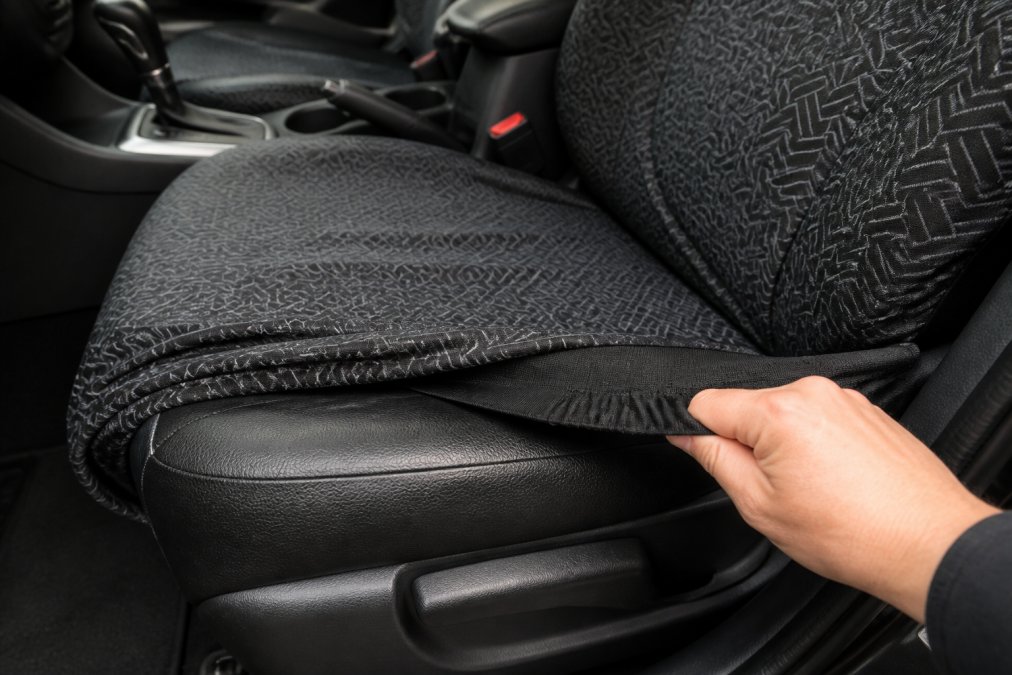
The Custom Fit Car Seat Covers at $45.97 cover front bucket seats, while the $51.81 full set adds rear bench coverage. Both use an elastic backing and fastening system that keeps the cover seated without tools. Installation takes minutes, and removal is just as clean, which matters if you lease.

How polyester microfiber compares to the alternatives.
- Neoprene: Excellent water resistance and grip, but heavier, traps heat, and can develop a rubber smell in a hot cabin.
- Synthetic leather (PU/PVC): Wipes clean and looks premium, but the surface layer can crack and peel as plasticizers migrate out under UV and heat, the failure mode most owners notice in year two or three.
- Cotton canvas: Breathable and cool, but absorbs spills, fades, and abrades faster than polyester.
- Polyester microfiber: Best balance of abrasion resistance, fade resistance, and washability, with the trade-off that it is not waterproof, it is water-resistant.
What works: The edge-to-edge print is fade-resistant, and the non-slip backing holds through daily entry and exit. What doesn't: Fits most standard car and SUV seats, but not every model, so measure before ordering. And because the fabric is water-resistant rather than waterproof, a full cup of coffee still needs a fast blot.
Auto Sun Shades: Double-Insulated Laminate Protection
Double-insulated laminate is the material that separates a real sun shade from a reflective sheet. The laminate layers trap heat before it reaches your dashboard, while the reflective surface bounces UV rays.
The Auto Sun Shades at $30.38 fold flat for storage, wipe clean, and fit most cars, trucks, and SUVs. Installation takes seconds: unfold, position against the windshield, and flip the visors down to hold it.

UV-protection matters most for dashboard plastics. A shade that blocks direct sun slows the heat and cooling cycle.
Essential Car Accessories for Summer Heat
Essential car accessories for summer heat fall into three jobs: block incoming radiation, protect contact surfaces, and keep air moving. Sun shades handle the first. Seat covers handle the second, especially synthetic leather and vinyl seats that hold heat. A small battery-powered fan covers the third.
The mistake most owners make is buying one item and expecting it to solve everything. A shade keeps the cabin cooler while parked, but it does nothing once you are driving. Covers protect upholstery from sweat and sunscreen, but they do not lower ambient temperature.
- Block: windshield sun shades with reflective laminate
- Protect: seat covers in breathable polyester microfiber
- Ventilate: a 12V or USB fan for parked cooldowns
- Maintain: a UV-protectant dressing for dash and trim
That last point connects to the next section, because protectant choice determines whether your trim lasts or turns chalky.
The Best Car Interior Protectant for Long-Term Use
The best car interior protectant for long-term use is a UV-blocking, non-greasy formula applied to clean surfaces, not a high-gloss dressing that attracts dust. Water-based protectants with UV inhibitors are a safer default for vinyl, plastic, and synthetic leather.
What protectant can and cannot do. Interior plastics and vinyls are formulated with plasticizers and UV stabilizers blended into the material at the factory. Sun exposure and heat cycles slowly drive those additives to the surface and evaporate them. A protectant replenishes a sacrificial layer on the surface and absorbs or reflects some UV before it reaches the substrate. It slows the process. It does not reverse it.
Why water-based beats solvent-based for most cabins. Water-based formulas leave a matte or satin finish and do not carry the strong solvent smell that off-gasses in a hot parked car. Solvent-based and silicone-heavy dressings can look glossy for a week, but the shine is often a film that attracts dust and migrates onto interior glass. That film is the source of the greasy haze you sometimes see on the inside of a windshield on a hot afternoon.
Match the product to the surface.
- Hard plastic (dash top, door uppers): UV-blocking water-based protectant, matte finish, reapplied monthly in peak sun.
- Vinyl and synthetic leather (seats, armrests): A dedicated vinyl conditioner or a protectant labeled safe for coated leather. Avoid anything with petroleum distillates, which can degrade the coating.
- Textured or matte trim: Skip dressings entirely. Many matte finishes are ruined by shine, and the texture holds product unevenly.
- Screens and piano-black trim: Microfiber and water only. Protectant streaks these surfaces permanently.
The reapplication interval is not arbitrary. Monthly during peak sun months is a reasonable default because the sacrificial layer degrades with cumulative UV exposure, not with calendar time. In a climate with intense summer sun, a car parked outdoors may need reapplication every three to four weeks. A garaged car in a milder climate can stretch to every six to eight weeks. The signal to reapply is when water stops beading on the surface and starts to sheet.
How protectant fits the durability system. Protectant is the maintenance layer, not the primary defense. The primary defense is reducing UV exposure in the first place, a windshield shade while parked, window tint where legal, and parking orientation that keeps the dash out of direct sun. Protectant then handles the residual exposure that gets past those measures. Pair the two and you extend the life of both the trim and the shade, since a cooler cabin means less thermal cycling.
A note on off-gassing. New interior plastics and aftermarket dressings both release volatile organic compounds (VOCs) into the cabin, especially in the first weeks and especially in heat (the EPA). If cabin air quality matters to you, for children, for sensitive passengers, or for your own comfort, choose low-VOC, water-based products, ventilate the cabin after application, and avoid applying dressings in a closed garage.
What to Avoid When Buying Durable Interior Accessories
The biggest mistake is buying on appearance alone. Check three things before any purchase: material composition, fitment method, and care instructions.
- Avoid "one-size-fits-all" covers unless you accept loose fitment and gaps
- Skip thin, single-layer sun shades that crease permanently after one fold
- Reject greasy protectants that leave residue on glass and dash
- Check wash instructions before buying anything in a light color
- Verify reversibility if you lease or plan to sell
For fitment specifically, custom-fit and universal-fit are not the same thing. Custom-fit covers follow seat contours; universal-fit relies on stretch. The covers in this review sit in the middle: universal elastic backing with a snug, non-slip result on standard seats.
Summer heat and daily wear will find every weak point in your interior, whether that is a cheap shade that flakes or a cover that slides. 4GodsYourGlory carries practical automotive accessories built for exactly this, including custom-fit car seat covers in polyester microfiber and double-insulated auto sun shades that fold flat for storage. Both install in minutes with no tools, and both clean up with a gentle wash or a wipe. Add the right protection before the next heat wave and your cabin stays comfortable and intact.
Frequently Asked Questions
What are the best car interior accessories for durability?
Durability comes down to material and fit. Polyester microfiber seat covers resist spills, stains and daily wear while staying soft, and double-insulated laminate sun shades block UV rays without cracking. Look for abrasion-resistant fabrics, elastic backing for a non-slip fit, and fade-resistant prints. These features keep accessories functional for years rather than one season, making them a better long-term investment for any vehicle.
Are universal car interior accessories as durable as custom-fit options?
Custom-fit accessories generally last longer because they stay in place. For maximum longevity, choose accessories designed for your seat shape or windshield size.
How do I choose high-quality automotive interior accessories?
Check the material first. Look for abrasion-resistant and UV-protection claims, plus installation that does not require tools. A snug, non-slip fit matters as much as fabric because movement causes premature wear. Read care instructions too; washable covers and easy-clean shades stay in service longer than delicate alternatives.
What interior car accessories are worth the investment for resale value?
Seat covers and sun shades protect the surfaces that buyers inspect first. Both are low-cost compared to reupholstery or dashboard replacement. Keeping original seats in good condition under covers can help you command a higher price when you sell or trade in.