
Table of Contents
- What You'll Need Before You Measure Shoe Size
- Step-by-Step: How to Measure Shoe Size at Home
- How to Measure Foot Width for the Right Fit
- Shoe Size Conversion Chart: US, UK, and International Sizes
- How to Tell If Shoes Fit Properly Once You Have Them On
- The Impact of Sock Thickness and Foot Conditions on Sizing
- Measuring Children's Feet vs. Adult Feet
- Common Mistakes That Lead to the Wrong Size
Last Updated: August 3, 2026
Getting shoe sizing wrong is one of the most common and costly mistakes in online footwear shopping. Knowing how to measure shoe size correctly before you buy can be the difference between a pair you wear every day and one that collects dust. This guide from 4GodsYourGlory covers everything you need to get an accurate measurement at home, including foot length, foot width, and how those numbers translate across sizing systems.
Your feet change size throughout the day, between seasons, and with age. The only reliable approach is to measure fresh, measure correctly, and cross-reference against a sizing conversion chart.
Total Time: 15 minutes Difficulty: Beginner
What You'll Need Before You Measure Shoe Size
Accurate sizing starts with the right tools:
- A blank sheet of paper (at least 8.5" x 11")
- A pencil or pen
- A ruler or measuring tape marked in both inches and centimeters
- A flat, hard floor (carpet distorts tracings)
- Socks you plan to wear with the shoes
Sock thickness directly affects how a shoe fits. Bring the socks you'll actually wear, not your thinnest pair.
If you have access to a Brannock Device, the metal measuring tool found in most shoe stores, use it. According to American Podiatric Medical Association fitting guidance, having feet measured while standing under full body weight is the most accurate method because the foot spreads under load.
For home use, the paper tracing method is reliable, free, and takes under five minutes.
Step-by-Step: How to Measure Shoe Size at Home
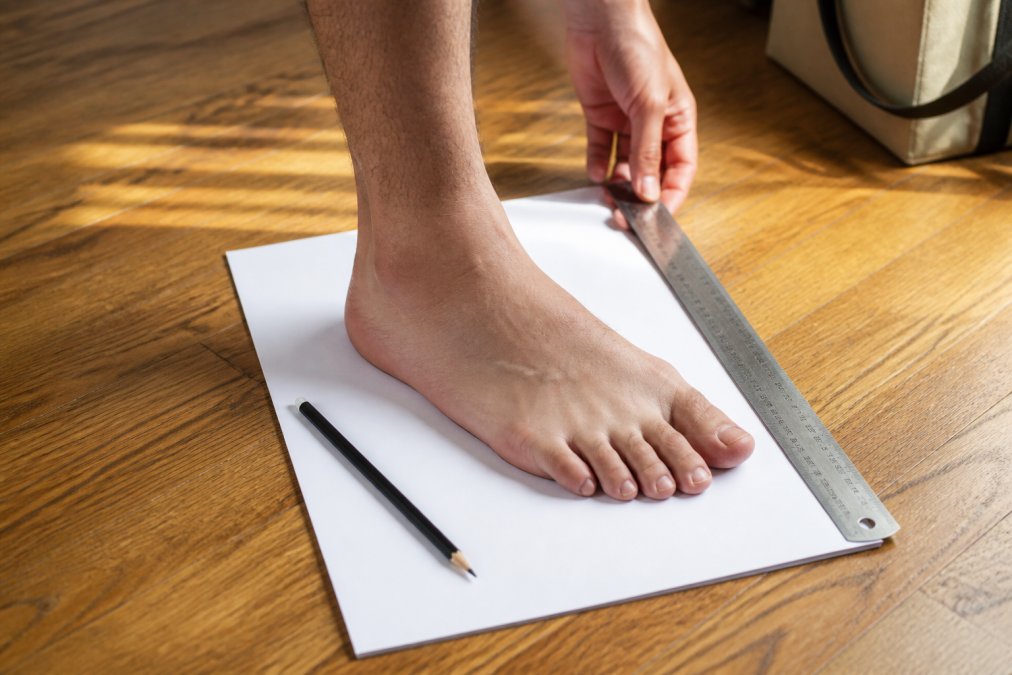
Step 1: Trace Your Foot on Paper
Place your paper on a hard, flat floor. Stand on the paper with your full weight distributed evenly. Keeping the pencil vertical (not angled), trace the outline of your foot. Angling the pencil inward creates a tracing smaller than your actual foot, the most common error at this stage.
Repeat for both feet. Most people have one foot slightly larger than the other. Always size for the larger foot.
Step 2: Measure Heel-to-Toe Length
Draw a straight line from the back of the heel to the tip of the longest toe. This heel-to-toe measurement is your primary sizing number. Measure it in both inches and centimeters. Also measure the widest point of your foot, typically across the ball of the foot, which determines your width category.
Step 3: Find Your Size on a Sizing Chart
Use the table below to convert your heel-to-toe measurement into a US shoe size:
| Foot Length (inches) | Foot Length (cm) | US Men's Size | US Women's Size |
|---|---|---|---|
| 8.5" | 21.6 cm | 5 | 6.5 |
| 9.0" | 22.9 cm | 6 | 7.5 |
| 9.5" | 24.1 cm | 7 | 8.5 |
| 10.0" | 25.4 cm | 8 | 9.5 |
| 10.5" | 26.7 cm | 9 | 10.5 |
| 11.0" | 27.9 cm | 10 | 11.5 |
| 11.5" | 29.2 cm | 11 | 12.5 |
| 12.0" | 30.5 cm | 12 | 13.5 |
If your measurement falls between two sizes, size up. A slightly longer toe box is far more comfortable than a shoe that creates pressure points at the tip of the toes.
How to Measure Foot Width for the Right Fit
Foot width is where most fit problems originate. A shoe can be the right length and still cause blisters, bunions, and heel slippage if the width is wrong.
Wide Width vs. Narrow Width: Which Category Are You?
Wrap a measurement tape around the widest point of your foot, which is the ball of the foot just below the toes. This gives you your foot circumference at its widest point.
Standard US width categories for men's shoes run from AAA (narrowest) through B, D (standard), E, EE, and EEEE (widest). Women's sizing follows a similar scale. Most mass-market shoes are built on a D-width last for men and a B-width last for women.
Width sizing reference:
| Category | Label | Common Fit Description |
|---|---|---|
| Narrow | AA / B (women), AA / A (men) | Slim foot, standard shoes feel loose |
| Standard | B (women), D (men) | Fits most off-the-shelf footwear |
| Wide | D (women), 2E (men) | Needs extra room in the toe box |
| Extra Wide | 2E (women), 4E (men) | Standard shoes cause pressure points |
The instep height also affects perceived width. A high instep can make a standard-width shoe feel tight across the top of the foot even when the width measurement suggests a standard fit.
Shoe Size Conversion Chart: US, UK, and International Sizes
Shoe size standards vary significantly across countries. The Mondopoint system, used primarily in military and athletic contexts, measures foot length in millimeters and is the most precise international standard. According to ASTM International footwear sizing standards, US sizing does not follow a perfectly linear scale, which is why a size 10 in one brand can feel like a 9.5 or a 10.5 in another.
| US Men's | US Women's | UK | EU | Mondopoint (mm) |
|---|---|---|---|---|
| 7 | 8.5 | 6 | 40 | 250 |
| 8 | 9.5 | 7 | 41 | 260 |
| 9 | 10.5 | 8 | 42 | 270 |
| 10 | 11.5 | 9 | 43-44 | 280 |
| 11 | 12.5 | 10 | 45 | 290 |
| 12 | 13.5 | 11 | 46 | 300 |
Size discrepancy between brands is significant. Measuring your foot in centimeters and cross-referencing against a brand's own sizing conversion chart is always more reliable than assuming your size transfers directly from one shoe to another.
How to Tell If Shoes Fit Properly Once You Have Them On
Put the shoes on with the socks you measured in. Stand up, walk around, and check each of the following:
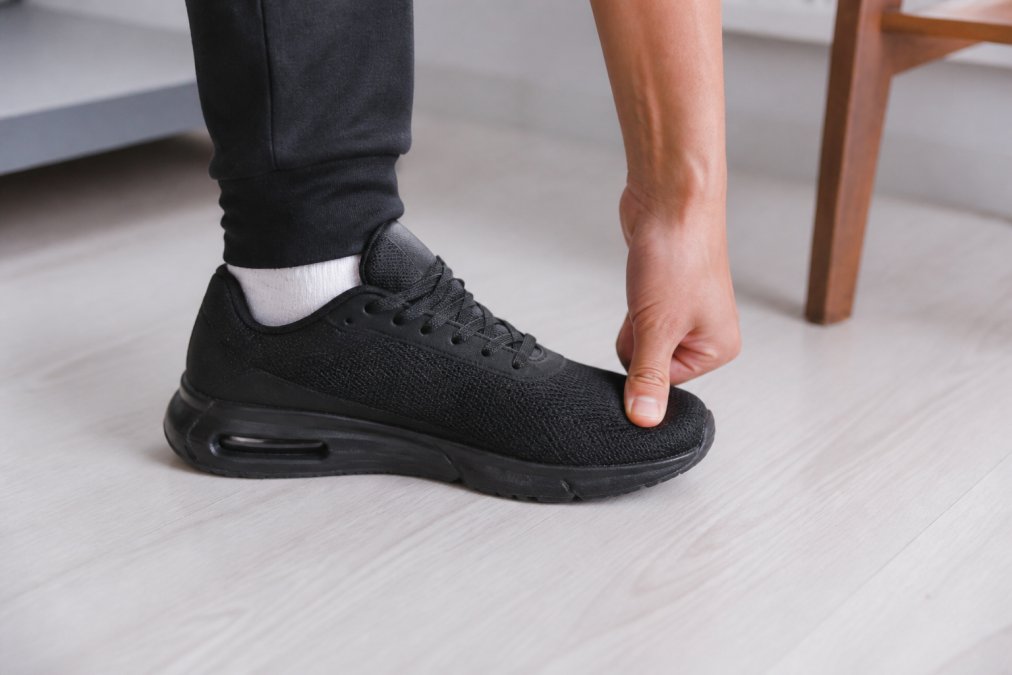
- Toe room: Press your thumb against the front of the toe box. You should feel roughly a thumb's width of space between your longest toe and the end of the shoe.
- Heel fit: Walk a few steps and check for heel slippage. The heel should stay in contact with the footbed.
- Width check: The widest part of your foot should align with the widest part of the shoe.
- Instep pressure: Lace the shoe fully and check for pressure across the top of the foot.
If you're shopping for sneakers designed for all-day wear, the [Air Max React Sneakers](https://fourgodsglory.org/products/sf_s36-air-max-react-sneakers-black) from 4GodsYourGlory are built with cushioned comfort specifically for walking, commuting, and long days on your feet. At $95.95, they're a solid option for active adults. The Sneakers - Black at $79.99 are a lighter alternative with breathable mesh construction.


The Impact of Sock Thickness and Foot Conditions on Sizing
Sock thickness is the most consistently overlooked variable in shoe sizing. A thin dress sock and a thick athletic sock can create more than a half-size difference in effective fit. Always measure and fit shoes while wearing the socks you intend to use with them.
Compression socks add volume to the foot and lower leg, which affects instep fit more than length. Account for that additional volume when selecting shoe depth and width.
Measuring for Specific Foot Conditions
Bunions: A bunion increases the width of the forefoot at the joint. Look for shoes with a wider toe box and softer upper material at the ball of the foot rather than simply sizing up in length.
Plantar fasciitis: This condition affects the arch and heel. Arch length, measured from the heel to the ball of the foot, becomes a critical measurement alongside total heel-to-toe length.
Edema or swelling: Feet that swell significantly should be measured at their largest point, typically late afternoon. Adjustable closures, such as wide velcro straps or extra-wide lacing systems, are more practical than chasing a fixed size.
According to American Orthopaedic Foot and Ankle Society on proper footwear, footwear that does not accommodate the shape of the foot is a leading contributor to preventable foot pain and injury.
Measuring Children's Feet vs. Adult Feet
Children's feet grow faster than most parents expect. Measure a child's feet every two to three months during peak growth periods, typically between ages 3 and 12.
The measurement process is identical to the adult method. The key differences are in interpretation and fit tolerance.
Children's fit guidelines:
- Allow 0.5" to 0.75" of growth room at the toe box
- Prioritize width over length; children's feet are proportionally wider relative to length than adult feet
- Avoid hand-me-down shoes; worn insoles conform to the previous wearer's foot shape
Adult feet tend to widen and flatten with age. Many adults wearing the same size they wore at 25 are actually wearing a shoe that is too narrow and too short by their 40s or 50s. A fresh measurement every few years is a practical habit.
Common Mistakes That Lead to the Wrong Size
Most shoe fit problems trace back to predictable errors:
Measuring only once, years ago. Foot dimensions change. Measure before every major shoe purchase.
Measuring on carpet. Carpet compresses under foot weight and distorts the tracing. Always use a hard floor.
Tracing with an angled pencil. Angling the pencil inward reduces the apparent size of the tracing. Keep the pencil perpendicular to the paper.
Sizing by brand feel rather than measurement. Brand sizing is inconsistent. Always cross-reference with the brand's own sizing chart.
Ignoring half sizes. If your measurement falls between two whole sizes, a half size is almost always the better fit.
Measuring only one foot. Size discrepancy between feet is common. Always measure both and size for the larger.
Buying shoes in the morning. Feet are at their smallest in the morning. Shoes that fit perfectly at 9 a.m. may feel tight by 3 p.m.
| Common Mistake | Root Cause | Fix |
|---|---|---|
| Shoes too tight by afternoon | Measured in the morning | Measure feet in the afternoon |
| Wrong width fit | Measured length only | Measure width at the ball of the foot |
| Size varies by brand | Assumed sizes transfer directly | Check each brand's own sizing chart |
| Heel slippage | Sized up for wide foot | Address width separately from length |
| Blisters on one foot | Measured only the smaller foot | Always size for the larger foot |
| Toe pressure after break-in | Insufficient toe box room | Allow a thumb's width of space at the toe |
Getting the right shoe size is straightforward when you approach it systematically: measure both feet in the afternoon, account for sock thickness, check both length and width, and verify against the specific brand's sizing chart. 4GodsYourGlory offers a curated selection of Air Max React Sneakers and everyday footwear designed for active adults who need comfort and reliability. Add the right pair to your cart using your measurements as your guide.
Frequently Asked Questions
Is shoe size measured in inches or centimeters?
Both units are used depending on the sizing system. In the US, shoe sizes are based on a scale derived from inch measurements, but the actual foot length is most accurately captured in inches or centimeters when you measure at home. A heel-to-toe measurement in inches or centimeters is then matched against a US sizing chart. Most printable foot measurement templates include both units so you can cross-reference easily.
How do I measure shoe size for wide feet?
Wrap a flexible measuring tape around the widest point of your foot, typically across the ball of the foot, to get your foot circumference. Compare that number against a width chart: standard width for men is D and for women is B. Wide width starts at 2E for men and D for women. If your circumference falls outside the standard range, look specifically for shoes labeled wide width (W or 2E/4E) to avoid pressure points and heel slippage.
What is the difference between US and UK shoe sizes?
US and UK shoe sizes use different numbering scales. For men, a US size 10 is roughly a UK size 9.5. For women, a US size 8 converts to approximately a UK size 6. The difference is generally 0.5 to 1 full size depending on gender. Always check a sizing conversion chart specific to the shoe's country of origin before ordering, since international size conversion errors are one of the most common reasons shoes don't fit when ordered online.
Does foot size change as you get older?
Yes, feet can change size with age. Ligaments and tendons loosen over time, which causes the arch to flatten and the foot to spread wider and sometimes longer. Pregnancy, weight changes, and prolonged standing can also shift your size. Adults should re-measure every year or two rather than assuming their size from a decade ago still applies. Always measure both feet and use the larger foot's measurement when selecting your size.
How do I know if my shoes are too tight?
Press your thumb down on the toe box just above your longest toe while standing. There should be roughly a thumb's width of space between your toe and the end of the shoe. If you can't fit any space, the shoe is too short. Other signs include pressure points along the sides of the foot, numbness after short wear, or visible bulging over the instep. Heel slippage in the opposite direction signals the shoe is too large.
When is the best time of day to measure your feet?
Measure your feet in the afternoon or evening. Feet naturally swell throughout the day due to standing weight and movement, reaching their largest size by late afternoon. Measuring in the morning often gives a slightly smaller reading, which can result in shoes that feel tight by the end of the day. For the most accurate sizing, measure after you've been on your feet for at least a few hours, and wear the socks you plan to use with the shoes.
This article was written using GrandRanker