
Table of Contents
- How to Spot Fake Air Max: Key Authentication Checks
- Step 1: Inspect the Tongue Label and Logo
- Step 2: Examine Stitching Quality and Consistency
- Step 3: Check Nike Size Tag Authentication
- Step 4: Verify the Box and Packaging Details
- Step 5: Perform a Nike Air Max Serial Number Check
- Step 6: Advanced Verification Methods
- Where to Buy Authentic Air Max Sneakers
Last Updated: August 8, 2026
How to Spot Fake Air Max: Key Authentication Checks
Counterfeit Air Max sneakers flood online marketplaces, and spotting fake Air Max shoes requires knowing exactly what to look for. The difference between authentic Nike Air Max and replicas often comes down to small details in stitching, materials, and packaging that most casual buyers overlook. At 4GodsYourGlory, we've compiled this step-by-step guide to help you verify authenticity before making a purchase.

Fake sneakers aren't just a waste of money, they fall apart faster, feel uncomfortable, and support criminal operations. Learning how to spot fake Air Max protects your investment and ensures you get the cushioning, durability, and style Nike promises. This guide walks you through six verification methods, from basic visual inspections to advanced technical checks.
Why Counterfeit Air Max Sneakers Are Everywhere
The Air Max line remains one of Nike's most counterfeited products because the shoes command premium prices and maintain consistent demand. Replicas are manufactured in bulk at a fraction of legitimate production costs, then distributed through unauthorized sellers, third-party marketplaces, and social media. Counterfeit operations have become sophisticated enough that surface-level checks no longer suffice.
The problem extends beyond just losing money on a fake purchase. Replica shoes often use toxic adhesives, substandard materials, and manufacturing processes that don't meet safety standards. Many counterfeit operations operate without labor protections or environmental controls, contributing to broader supply chain issues.
Step 1: Inspect the Tongue Label and Logo
The tongue label is one of the easiest places to spot a counterfeit Air Max. Authentic Nike tongue labels feature crisp, evenly-spaced text with consistent font density and proper bolding on key words. The Nike Swoosh logo should be perfectly centered and symmetrical.

On fake Air Max shoes, the tongue label often shows these irregularities: uneven text spacing, inconsistent font weight, fuzzy or blurry lettering, misaligned logos, or poor ink density. The text may appear too thin or too bold compared to authentic examples. Counterfeit manufacturers frequently struggle with the precision required for proper embroidery and printing.
Check these specific details on the tongue label:
- Font size consistency across all text
- Proper spacing between letters and words
- The Nike Swoosh centered and not tilted
- Ink color matching Nike's standard (typically black or white depending on colorway)
- No visible glue residue or manufacturing defects around the edges
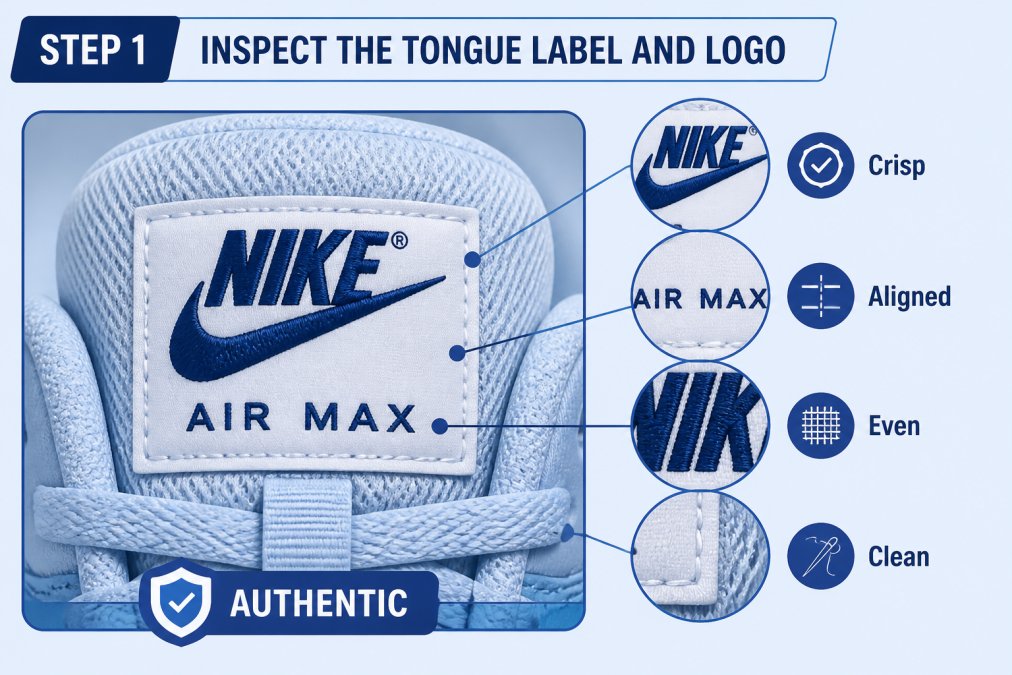
Comparing your shoe's tongue label to official Nike product images from their website provides a reliable baseline. Authentic Air Max tongues feel smooth to the touch, while counterfeit labels often have rough edges or uneven texture from poor manufacturing.
Step 2: Examine Stitching Quality and Consistency
Stitching quality separates legitimate Air Max shoes from replicas faster than almost any other single factor. Nike uses industrial-grade machines with precise tension control, resulting in uniform stitch spacing, straight seams, and consistent thread color throughout the shoe.
Counterfeit Air Max shoes typically show these stitching problems: uneven spacing between stitches (varying from tight to loose within the same seam), thread color that doesn't match Nike's standards, crooked or wavy seams especially around the toe box and heel, missing stitches or gaps in the seam line, or thread that appears frayed or poorly anchored at the seams' endpoints.
Run your finger along the main seams on both shoes to feel for irregularities. Authentic stitching should feel smooth and uniform. Pay particular attention to:
- The seam running along the side of the shoe (lateral seam)
- Stitching around the toe box perimeter
- The heel seam where the back panel connects
- Stitching on the tongue attachment points
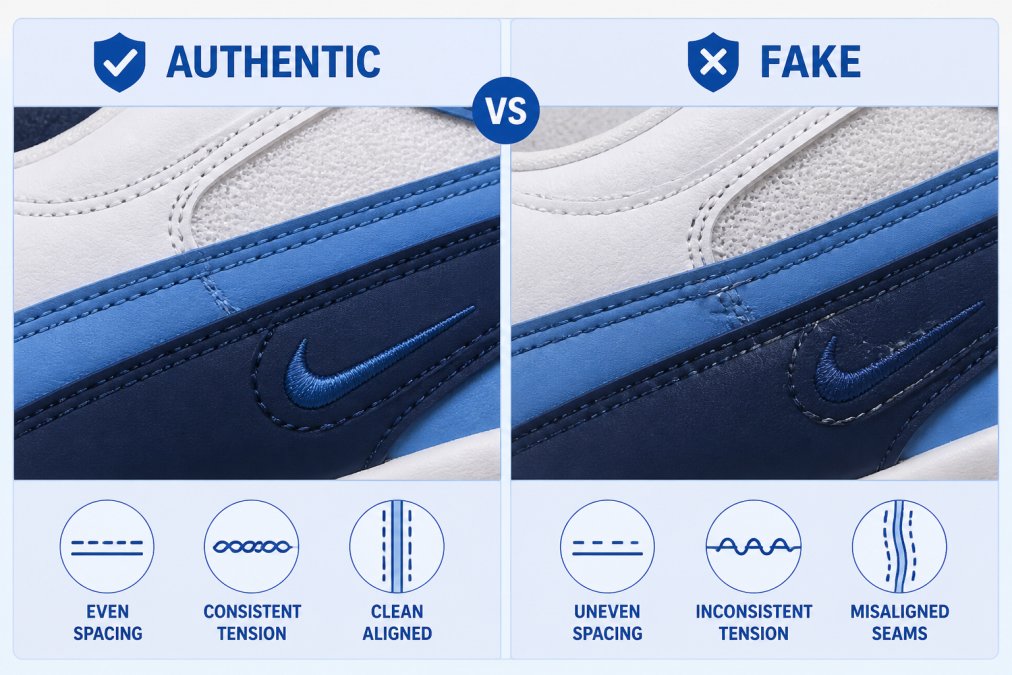
Fake Air Max shoes often have visible irregularities within a single seam, tight stitches in one section, loose stitches nearby. This inconsistency reflects manual or poorly-calibrated machine work. Authentic Nike manufacturing maintains tension consistency across every seam.
Step 3: Check Nike Size Tag Authentication
The size tag inside the shoe contains multiple authentication markers that counterfeiters frequently get wrong. Nike's size tags use specific formatting, font styles, and information layout that varies slightly by production year and region.
Examine the size tag for these details:
- Font consistency and proper bolding of key information
- Correct spacing between the Nike Swoosh and text
- Proper alignment of the size number and shoe width designation
- Accurate barcode formatting and spacing
- The correct manufacturing country code (typically Vietnam, China, or Indonesia)
- Proper ink density, text should be crisp, not faded or overly dark
Counterfeit size tags commonly show: misaligned text, inconsistent font sizes, blurry or smudged printing, incorrect country codes, malformed barcodes, or spacing that doesn't match authentic examples. The barcode should scan properly if you have access to a barcode reader.
Compare your shoe's size tag to official Nike documentation or product photos from authorized retailers. The tag should feel securely attached to the insole, not loose or peeling. Authentic Nike size tags use specific adhesive that holds firmly without degrading the insole material.
Step 4: Verify the Box and Packaging Details
Nike's packaging reveals authenticity through several specific markers. The box label, printing quality, and construction details all follow Nike's manufacturing standards.
Check the box for:
- Correct font on the size and product information label
- Proper spacing and alignment of text on the lid and sides
- High-quality printing with no smudging, bleeding, or color inconsistencies
- Accurate barcode formatting and placement
- Correct Nike Swoosh logo size and positioning
- Proper box construction with clean edges and secure seams
Counterfeit boxes often show poor print quality, misaligned text, incorrect label placement, flimsy construction, or barcodes that don't match Nike's standard format. The box material itself may feel thinner or lower-quality than authentic Nike packaging.
The shoe box should have a specific weight and feel. Authentic Nike boxes use sturdy cardboard with proper thickness. Replica boxes often feel lighter or flimsier because manufacturers use cheaper materials to reduce production costs.
Inside the box, authentic Air Max shoes include tissue paper with the Nike Swoosh logo printed on it. Counterfeit versions either omit this tissue entirely or use plain white tissue without the logo. The tissue paper quality and ink density provide another verification point.
Step 5: Perform a Nike Air Max Serial Number Check
Some Air Max models include serial numbers or production codes that can be verified through Nike's official channels. Not all Air Max versions have serialized codes, but when they do, this provides definitive authentication.
Look for production codes or serial numbers on:
- The insole (often printed on the back portion)
- The size tag interior
- The heel tab area
- The tongue tag attachment point
If your Air Max includes a serial number, visit Nike's official website or contact their customer service to verify the code matches their production records. Authentic serial numbers follow specific formatting patterns and correspond to legitimate manufacturing batches.
Counterfeit shoes either lack serial numbers entirely or include randomly-generated codes that don't match Nike's system. This check works best for newer Air Max models where Nike has implemented serialization as standard practice.
Step 6: Advanced Verification Methods
Beyond visual inspection, several technical methods provide additional authentication confidence. These checks require specific tools or conditions but offer high accuracy.
UV Light and Blacklight Testing
Authentic Nike Air Max shoes often contain materials that react visibly under ultraviolet light. Some stitching, adhesives, and materials in genuine Air Max shoes fluoresce or show specific colors when exposed to blacklight.
To perform this test, use a standard UV or blacklight flashlight in a dark room. Shine the light on different parts of the shoe:
- The stitching and seams
- The midsole area
- The insole
- The heel tab
Authentic Air Max shoes typically show subtle fluorescence or color changes under UV light in specific areas, particularly where Nike uses certain dyes or adhesives. Counterfeit shoes either show no UV reaction or show reactions in unexpected areas because replicas use different materials.
This test requires familiarity with what authentic Air Max models look like under UV light. Comparing your shoe to verified authentic examples under the same UV light provides the most reliable results. Many sneaker authentication groups maintain UV light test documentation for specific Air Max models.
Weight Comparison and Material Feel
Authentic Air Max shoes have a specific weight range based on their size and model. Counterfeits often feel noticeably heavier or lighter because they use different materials or add extra padding to compensate for poor cushioning performance.
Weigh your Air Max on a digital scale and compare the result to Nike's official specifications. Most Air Max shoes in size 10 weigh between 10-12 ounces per shoe. Significant deviations suggest a counterfeit.
Beyond weight, feel the materials:
- The midsole should feel firm but slightly yielding under pressure
- The upper material should feel supple and high-quality (leather or textile depending on model)
- The insole should feel cushioned and supportive, not thin or flimsy
- The outsole rubber should feel dense and substantial
Counterfeit Air Max shoes often use cheaper synthetic materials that feel plasticky, thin, or overly stiff. The cushioning feels inadequate or uneven. Genuine Nike Air Max React Sneakers, like those available at 4GodsYourGlory, use premium materials throughout that feel noticeably better in hand.
The Smell Test
Authentic Nike Air Max shoes have a specific smell profile related to the materials and adhesives used in manufacturing. Genuine shoes typically have a clean, slightly chemical smell from the materials and manufacturing process.
Counterfeit shoes often have a distinctly different or stronger chemical smell, sometimes described as harsh or overwhelming. This results from the use of lower-quality adhesives, cheaper synthetic materials, and less stringent manufacturing standards.
Smell your Air Max shoes, particularly:
- Inside the shoe near the insole
- The midsole area
- The interior of the tongue
Be aware that this test has limitations. All new shoes have some chemical smell, and individual sensitivity to odors varies. Use this as a supporting check rather than a definitive test. If the smell is overwhelmingly strong or noticeably different from other Nike shoes you own, it may indicate a counterfeit.
Where to Buy Authentic Air Max Sneakers
Purchasing from authorized retailers eliminates counterfeit risk entirely. Official Nike stores, Foot Locker, Champs Sports, and verified online retailers all guarantee authenticity.
4GodsYourGlory offers a curated selection of authentic Air Max React Sneakers priced at $95.95, combining quality and value. Our straightforward online shopping experience ensures you receive legitimate products. When you purchase Air Max sneakers from 4GodsYourGlory, you get the authentic cushioning, durability, and style that made Air Max a staple of athletic footwear.
| Authentication Method | Difficulty Level | Time Required | Reliability |
|---|---|---|---|
| Tongue label inspection | Easy | 2-3 minutes | High |
| Stitching examination | Easy | 3-5 minutes | High |
| Size tag verification | Easy | 2-3 minutes | High |
| Box and packaging check | Easy | 3-4 minutes | Medium-High |
| Serial number verification | Medium | 5-10 minutes | Very High |
| UV light testing | Medium | 5 minutes | Medium-High |
| Weight comparison | Medium | 3-5 minutes | Medium |
| Smell assessment | Easy | 1 minute | Low-Medium |
The most reliable approach combines multiple verification methods. No single check guarantees authenticity, but using three or four of these techniques together provides confidence in your purchase. When in doubt, buy from authorized retailers where authenticity is guaranteed. The peace of mind and assurance of genuine Nike Air Max quality justifies purchasing from verified sources like 4GodsYourGlory, where we stand behind every product with our commitment to delivering authentic footwear that meets your daily needs.
Frequently Asked Questions
How do I know if my Air Max is original?
Check three key areas: the Nike size tag authentication (font should be crisp with proper spacing), the tongue label (should have clear branding with no fuzziness), and the stitching (should be even and consistent throughout). Authentic Air Max sneakers also have proper material texture, synthetic and leather components feel premium and aligned. If you're unsure, use a UV light to inspect ink density on tags and logos; counterfeits often show irregularities under blacklight.
What are the most common signs of counterfeit sneakers?
Fake Air Max typically show poor stitching with uneven spacing, misaligned logos on the tongue label, and glue residue visible on the midsole or around the eyelets. The size tag may have incorrect font density or bolding. Packaging is also telling, counterfeit boxes often have misspelled text, incorrect barcode formatting, or low-quality printing. The heel tab embroidery should be crisp; replicas usually show fuzziness or loose threads.
Can I verify Air Max authenticity using a serial number?
Yes. Authentic Air Max sneakers include a manufacturing serial number on the size tag. This number should match Nike's official records if you contact Nike directly or check through authorized retail partners. The serial number format is specific to each colorway and production batch. If a seller cannot provide this information or the number doesn't match Nike's database, the sneaker is likely a replica.
How can I tell if Nikes are fake by the box?
Inspect the box label carefully: authentic Nike boxes have sharp printing, correct font spacing, and accurate barcode formatting. The box itself should feel sturdy and be properly sealed. Counterfeit boxes often show ink irregularities, misspelled text, or poor color alignment. Check that the box label matches the shoe's colorway and size tag exactly. Authentic boxes also include proper UPC codes and manufacturing information printed clearly.
This article was written using GrandRanker