
Table of Contents
- What You'll Need Before You Start Inspecting
- How to Spot Fake Sneakers: Stitching, Glue, and Build Quality
- Box Label, Typography, and Packaging Inspection
- Sneaker Authentication: Materials, Weight, and Smell
- Tongue Tag, Size Label, and Interior Details
- How to Authenticate Jordans: Model-Specific Red Flags
- How to Authenticate Nike Dunks Using Macro-Photography
- Legit Check Sneakers: Digital Tools and Resale Platform Policies
Last Updated: August 2, 2026
Counterfeit sneakers are a serious problem in the US resale market. Knowing how to spot fake sneakers before you buy can save you real money and frustration. This complete visual guide helps you inspect every detail, from stitching density to sole construction. Most buyers focus only on the box or colorway, that's the first mistake. The real tells are in the build quality, and once you know what to look for, fakes become obvious fast.
Sneaker authentication is the process of verifying that a pair of shoes matches the original manufacturer's specifications across materials, construction, labeling, and packaging. A pair that fails even two or three of the checks below should raise immediate concern.
What You'll Need Before You Start Inspecting
Good authentication starts with the right setup. Gather these tools:
- A bright flashlight or ring light
- A magnifying glass or macro lens attachment for your phone
- A digital scale that measures in grams
- The original retail box and all accessories
- A reference image from a verified authentic pair of the same model and colorway
Lighting matters more than most people realize. Fakes often look convincing under dim lighting. Bright, neutral white light exposes uneven stitching, color mismatches, and poor finishing. A $15 clip-on macro lens lets you photograph details at a level that reveals font inconsistencies and thread quality the naked eye misses.
How to Spot Fake Sneakers: Stitching, Glue, and Build Quality
Build quality is the fastest and most reliable way to identify a counterfeit. Authentic sneakers from major manufacturers go through strict quality control, and the evidence shows in the consistency of every seam.
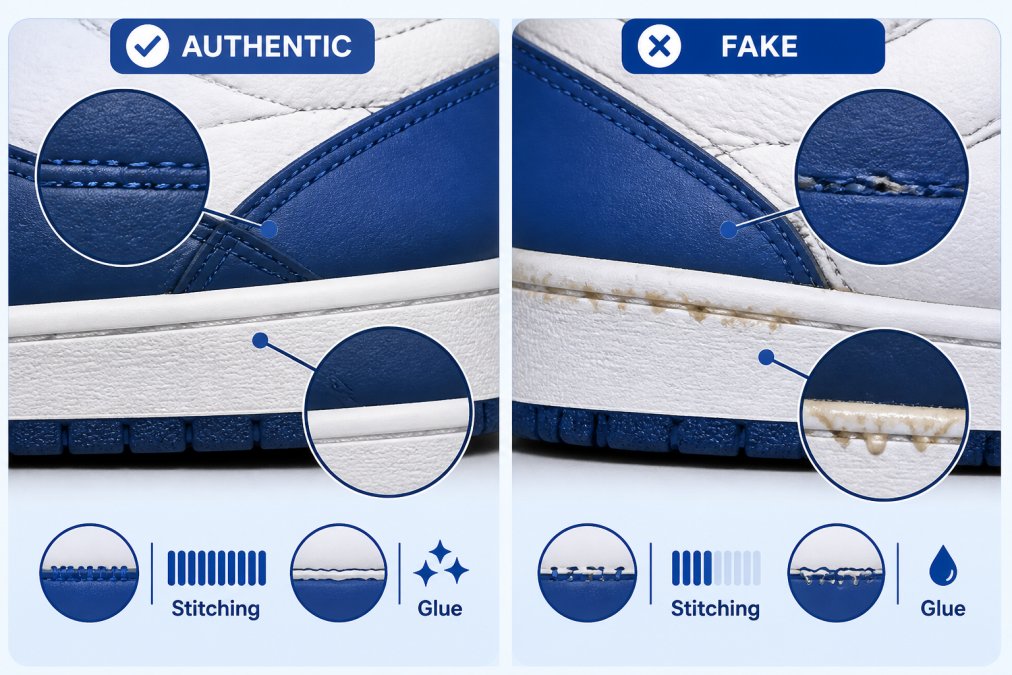
Stitching Density and Thread Consistency
Stitching density, measured in SPI (stitches per inch), is one of the clearest indicators of manufacturing quality. Authentic sneakers maintain consistent SPI across every seam. Replicas frequently cut corners here because precision stitching machines are expensive and slow.
What to look for:
- Consistent SPI: Run your finger along any seam. The spacing between stitches should feel uniform. Uneven gaps or bunching indicate a lower-grade machine or rushed production.
- Thread color match: On authentic pairs, thread color is matched precisely to the surrounding material. Fakes often use a slightly off-shade thread that becomes obvious in direct light.
- No loose threads: A single loose or pulled thread along a major seam is a red flag.
- Straight seam lines: Crooked or wavy seam lines along the toe box or heel counter are common factory defects in counterfeits.
The stitching on the tongue label and heel panel deserves extra attention. These areas are harder to replicate cleanly, and counterfeit manufacturers frequently rush them.
Glue Residue and Sole Bonding
Glue application is another area where fakes consistently fail. Examine the perimeter where the upper meets the midsole. On a genuine pair, the bond line is clean and even. On a replica, you'll commonly find visible glue squeeze-out, uneven bonding, or discoloration along the bond line.
Press gently on the midsole edge around the full perimeter. Any flex or separation is an immediate fail. According to the US Consumer Product Safety Commission's product quality standards, consistent adhesive bonding is a baseline manufacturing requirement for footwear sold in the United States.
Box Label, Typography, and Packaging Inspection
Authentic sneaker boxes use precise, consistent typography across every printed element. Replicas typically show slightly bolder or thinner font weight, inconsistent letter spacing, blurry text under magnification, or color shifts in the brand logo.
Hold the box label at an angle under your flashlight. Authentic labels have a clean, flat print surface. Counterfeit labels often show micro-texture inconsistencies or slightly raised ink from lower-quality printing.
Barcode, QR Code, and Serial Number Verification
Every authentic pair ships with a barcode and, on many modern models, a QR code. The serial number printed on the box label should match the serial number on the tongue tag and insole exactly.
Steps to verify:
- Scan the barcode with any standard barcode scanner app. It should return a valid product entry.
- Scan the QR code if present. Authentic QR codes link to official product pages or authentication portals.
- Compare the serial number on the box label to the tongue tag. Any mismatch is an immediate fail.
- Check that the size, colorway code, and country of manufacture on the label match the shoe itself.
A common mistake is assuming that a working barcode means the shoe is authentic. Counterfeit operations frequently copy valid barcodes from authentic pairs.
Sneaker Authentication: Materials, Weight, and Smell
Material quality is where premium leather and synthetic materials tell very different stories. Run your hand across the upper material. Authentic premium leather has a consistent grain texture and a slight natural give. Counterfeit uppers frequently feel stiffer, show irregular grain patterns, or have a plastic-like surface sheen.
The smell test is underused and genuinely effective. Authentic sneakers have a faint rubber and material smell. Replicas often have a stronger chemical smell from lower-grade adhesives. According to the American Apparel & Footwear Association's manufacturing standards resource, material grade consistency is a documented differentiator between authentic and counterfeit footwear.
Weight is another reliable check. Weigh both shoes individually on a digital scale. They should be within a few grams of each other. Significant weight discrepancy between the left and right shoe indicates inconsistent manufacturing.
Insole, Midsole, and Outsole Construction
Pull out the insole and examine it directly. Authentic insoles have consistent padding density, clean stitching around the perimeter, and precise logo printing. Counterfeit insoles frequently show thin or uneven padding, blurry logo printing, or rough edges.
The midsole should be examined for color consistency. Authentic midsoles maintain uniform color across the full surface. The outsole material should feel dense and grippy. Counterfeit outsoles frequently use softer, cheaper rubber that feels slightly tacky.
Sole Flexibility, Grip, and Padding
Hold the shoe at the toe and heel and bend it gently. The flex point should fall naturally at the ball of the foot, not at the arch or mid-midsole. Counterfeit soles often flex in the wrong location or feel uniformly stiff. Authentic outsole grip patterns are deeply molded and consistent. Replica grip patterns are frequently shallower and less defined.
Tongue Tag, Size Label, and Interior Details
The tongue tag is one of the most frequently faked elements and one of the most revealing. Examine it under magnification. On authentic pairs, the tongue tag stitching is tight and even, the font is crisp, and the sizing text aligns perfectly within the label border. Counterfeit tongue tags commonly show font weight inconsistencies, stitching that puckers at the corners, or size text that sits off-center.
The interior of the shoe deserves a full inspection. Run your hand along the interior lining. Authentic pairs have smooth, consistent lining with no rough edges. Check the heel counter by pressing it from the outside. It should be firm and consistent.
How to Authenticate Jordans: Model-Specific Red Flags
Jordan authentication requires model-specific knowledge because the red flags vary significantly between silhouettes.
For Jordan 1s, the key inspection points are:
- Wings logo placement: The Wings logo on the ankle collar should be centered and level.
- Toe box shape: Authentic Jordan 1s have a specific toe box curvature. Replicas frequently produce a flatter or more squared toe.
- Heel tab stitching: The heel tab should be stitched flat with consistent tension.
For Jordan 4s, focus on:
- Mesh netting quality: The side mesh panels on authentic Jordan 4s have a specific mesh density.
- Lace lock tabs: The plastic lace lock tabs should be consistent in color and molding.
- Midsole paint: The midsole uses a specific paint application. Replicas often show brush marks or uneven coverage.
The Sneaker Authenticators Association's model authentication database maintains detailed reference guides for major Jordan silhouettes.
How to Authenticate Nike Dunks Using Macro-Photography
Nike Dunks are among the most counterfeited sneakers in the US market in 2026. A phone macro lens lets you photograph at 10-15x magnification, revealing details invisible to the naked eye.
For Nike Dunks specifically, focus your macro lens on:
- Swoosh stitching: The Swoosh on authentic Dunks is stitched with consistent tension and precise SPI. Replica Swoosh stitching frequently shows uneven spacing or thread color variation.
- Heel embroidery: The Nike heel embroidery on authentic Dunks is sharp and consistent. Replicas show pixelation-like imprecision.
- Toe cap perforations: Authentic Dunk toe cap perforations are clean, uniform circles. Counterfeit perforations are frequently slightly oval or inconsistent in diameter.
Macro-photography also works well for font inspection on the tongue tag and insole. Print quality issues that look minor to the naked eye become obvious at 10x magnification.
| Inspection Area | Authentic Tell | Common Fake Fail |
|---|---|---|
| Stitching (SPI) | Consistent spacing, matched thread | Uneven gaps, off-shade thread |
| Glue/Sole Bond | Clean, flush bond line | Visible squeeze-out, edge lifting |
| Box Typography | Crisp, consistent font weight | Blurry text, spacing errors |
| Tongue Tag | Centered text, tight stitching | Off-center font, puckered corners |
| Insole Padding | Even density, clean edges | Thin, uneven, rough cut edges |
| Outsole Grip | Deep, defined pattern | Shallow, inconsistent molding |
| Material Smell | Faint rubber/material smell | Strong chemical odor |
| Weight | Consistent L/R within grams | Noticeable weight discrepancy |
Legit Check Sneakers: Digital Tools and Resale Platform Policies
Manual inspection is essential, but digital tools have changed the authentication landscape. Several dedicated authentication apps operate in the US market and provide real-time legit check services using AI image analysis and human expert review.
These tools allow you to submit 8-12 photos covering the box label, tongue tag, stitching, sole, and materials. Turnaround times range from minutes for automated checks to 24-48 hours for expert review. They're good at catching replica pairs that fail on typography, stitching, or construction, but less reliable on high-quality "1:1" replicas. For those, physical weight comparison and smell testing remain most reliable.
A practical approach is to use digital verification as a first filter and physical inspection as the final confirmation.
Secondary Market Platform Policies in the US
The major US secondary market platforms have authentication policies that vary significantly. Some authenticate every pair before shipping to the buyer. Others offer optional authentication at an added fee. Some rely entirely on seller reputation and buyer protection policies.
Key points for US buyers:
- Platforms that authenticate in-house typically hold the pair at a verification facility before shipping, providing an additional layer of protection.
- Buyer protection policies vary. Some platforms offer full refunds for authenticated fakes; others offer store credit only.
- "Verified" badges on listings do not always mean the platform physically inspected the pair.
According to the Federal Trade Commission's consumer guidance on counterfeit goods, US consumers have legal protections when purchasing counterfeit goods unknowingly, but the remedy available depends heavily on the platform's stated policies.
Buying fake sneakers is a frustrating and expensive mistake that's entirely avoidable with the right inspection process. At 4GodsYourGlory, we carry a curated selection of Air Max React Sneakers, ensuring customers have access to essential footwear. Our straightforward online shopping experience is built for buyers who want reliable footwear without the guesswork of the secondary market. Add a pair from 4GodsYourGlory and get the authentic sneaker experience your daily routine deserves.
Frequently Asked Questions
What are the most common giveaways of fake sneakers?
The most reliable giveaways are uneven stitching, glue residue along the midsole, font misalignment on the box label, and off-color materials. Counterfeit sneakers often use synthetic materials where authentic pairs use premium leather or engineered mesh. Checking the tongue tag for clean printing and correct sizing information is another fast way to spot a replica before you even put the shoe on.
How can you tell if a sneaker box is fake?
Inspect the box label for font alignment, barcode clarity, and serial number formatting. On authentic pairs, the serial number on the box matches the number printed on the insole or tongue tag exactly. Counterfeit boxes frequently show blurry barcodes, inconsistent spacing between characters, or slightly wrong font weights. The box itself may also feel lighter or flimsier than an authentic one.
Are there apps or services to authenticate sneakers for a legit check?
Yes. Several digital verification services operate in the US market, including CheckCheck, Legit App, and Sneaker Con's authentication service. These platforms let you submit photos and receive a verdict, often within hours. Some US-based resale platforms also build authentication into their selling process, holding and inspecting pairs before releasing funds. For high-value pairs, using a dedicated authentication service before purchase is strongly recommended.
How do fake sneakers smell compared to real ones?
Authentic sneakers typically have a mild rubber or leather scent from quality materials and standard factory adhesives. Counterfeit pairs often have a noticeably sharp chemical smell from lower-grade glue and synthetic materials. The smell fades quickly on real pairs but can linger on fakes. While smell alone is not enough to confirm authenticity, a strong chemical odor on a new pair is a reliable warning sign worth investigating further.
What are common flaws in fake Nike Dunks that give them away?
Fake Nike Dunks frequently show stitching that is too loose or too tight compared to the authentic SPI count, misaligned Swoosh placement, and outsoles that feel stiff rather than flexible. The tongue tag on counterfeits often has slightly blurry text or incorrect font weight. Macro-photography of the heel area often reveals uneven finishing and inconsistent paint application that is invisible to the naked eye.
How can you tell if Air Jordans are fake?
Authenticating Jordans starts with the Jumpman logo: on real pairs the figure is clean, proportionate, and sharply printed. Fakes often show a thicker or slightly distorted silhouette. Check the insole for correct branding and padding density. The outsole pivot circle should be centered and the grip pattern precise. Box label serial numbers must match the tongue tag exactly. Colorway-specific details, like stitching color on the collar, vary by model and are frequently wrong on replicas.
This article was written using GrandRanker