
Table of Contents
- What Nike React Cushioning Actually Does
- Nike React vs Adidas Boost: Core Differences
- How to Choose Sneaker Cushioning for Your Needs
- Energy Return and Responsiveness Across Foam Types
- Durability of Nike React Foam Over Time
- Weight, Density, and Ground Feel Comparison
- Temperature Sensitivity and Real-World Performance
- Conclusion: Which Cushioning Wins for Daily Wear
- Frequently Asked Questions
Last Updated: September 3, 2026
What Nike React Cushioning Actually Does
Nike React cushioning is a proprietary foam technology designed to balance impact absorption with energy return, creating a responsive feel that doesn't sacrifice comfort. Unlike traditional EVA foam, which breaks down predictably over time, Nike React uses a thermoplastic polyurethane compound engineered to maintain its structural integrity through extended wear cycles.
The core function of Nike React cushioning is straightforward: absorb vertical impact from your foot strike while returning enough energy to reduce the work your legs must do. This dual function matters because most foam technologies force a trade-off. Soft foams absorb impact well but feel sluggish. Firm foams feel responsive but punish your joints. Nike React attempts to occupy the middle ground, which is why it shows up in everything from casual sneakers to performance running shoes.
When you land in a shoe with Nike React foam, the material compresses to absorb the shock. The polymer structure then rebounds, pushing energy back into your stride. This energy return reduces what's called vertical oscillation, the up-and-down motion your body experiences with each step. Less oscillation means less energy wasted, which translates to less fatigue over long days on your feet.
At 4GodsYourGlory, we stock Air Max React Sneakers that showcase this technology at an accessible price point. The shoes combine Nike React cushioning with a TPU and EVA soft outsole, delivering the responsive feel that made the technology popular without the premium price tag attached to flagship Nike models.

Nike React vs Adidas Boost: Core Differences
The comparison between Nike React and Adidas Boost reveals fundamentally different approaches to cushioning design. Nike React prioritizes energy return through its thermoplastic polyurethane structure, while Adidas Boost uses expanded polystyrene beads suspended in a TPU matrix. The material science differs, and so do the real-world performance characteristics.
Nike React delivers a more uniform compression feel. The foam responds consistently across different impact zones, which works well for casual wear and moderate-intensity activities. Adidas Boost, by contrast, feels bouncier due to the individual bead structure, each tiny sphere compresses independently, creating a springy sensation that many runners find engaging.
Ground feel differs noticeably between the two. Nike React provides a more connected sensation to the ground because the foam compresses as a cohesive unit. Adidas Boost creates more separation between your foot and the surface due to the air gaps between beads. Some athletes prefer this isolation for joint protection; others find it reduces their ability to sense the ground and adjust their gait accordingly.
Durability patterns also diverge. Nike React foam experiences compression set, permanent deformation, at a measurable rate over time. Most wearers notice a softening effect after 200-300 miles of use. Adidas Boost beads maintain their individual structure longer but can develop visible creasing in high-stress areas. Neither approach is objectively superior; they simply degrade differently.
The cost structure reflects these differences. Nike React shoes typically cost less to manufacture, which is why Air Max React Sneakers at 4GodsYourGlory retail for $95.95, a price point that positions them competitively against mid-tier Boost models. Adidas Boost commands higher pricing due to the more complex manufacturing process required to suspend and stabilize thousands of individual beads.
How to Choose Sneaker Cushioning for Your Needs
Selecting the right cushioning technology depends on three variables: your primary activity, your body weight, and your personal sensitivity to ground feel. No single cushioning type works best for everyone because different bodies respond differently to foam compression and energy return.
If you spend most of your day walking or standing, Nike React cushioning suits casual use well. The moderate responsiveness doesn't feel sluggish during short transitions, and the impact absorption protects your joints during extended periods on your feet. The technology shines in commuting scenarios and all-day wear because it maintains consistent performance without requiring high-intensity muscle engagement.
For long-distance running, the decision becomes more complex. Runners weighing under 160 pounds often prefer the lighter, more responsive feel of Nike React because the material rebounds quickly without requiring significant muscular effort. Heavier runners, 180 pounds and above, may find that Nike React compresses too much under sustained impact, reducing its energy return benefit. In those cases, firmer cushioning or a hybrid approach works better.
Ground feel preference is personal but trainable. If you've worn soft, isolating cushioning for years, switching to Nike React's more connected feel requires an adjustment period. Your proprioceptive system, the sensory feedback that tells your body where it is in space, adapts over 1-2 weeks of consistent wear. Athletes who value precise foot placement, like basketball players or trail runners, often prefer the ground connection that Nike React provides.
Your budget also factors into the decision. Nike React technology appears across price ranges, from budget models under $80 to premium versions exceeding $150. At 4GodsYourGlory, the Air Max React Sneakers deliver the core cushioning benefits at $95.95, making the technology accessible without requiring a luxury purchase. This price-to-performance ratio matters because you can test whether Nike React suits your needs without significant financial commitment.
Energy Return and Responsiveness Across Foam Types
Energy return, the amount of force the foam releases back into your stride, varies dramatically across cushioning technologies. Nike React returns approximately 75-80% of the energy absorbed on impact, measured through laboratory compression testing (peer-reviewed research). This means roughly one-quarter of your impact energy dissipates as heat, which is normal for any foam material.
Traditional EVA foam, the standard in budget sneakers, returns roughly 60-65% of impact energy. The material breaks down quickly under repeated stress, so energy return decreases measurably after 100-150 miles of use. This degradation is why budget sneakers feel noticeably softer after a few months of regular wear.
Adidas Boost returns approximately 80-85% of impact energy due to the bead structure's ability to rebound independently. However, this higher energy return comes with a trade-off: the individual beads create micro-movements that some wearers experience as instability during lateral movements. Nike React's unified foam structure provides slightly lower energy return but better overall stability during multi-directional activity.
Responsiveness, how quickly the foam rebounds after compression, depends on the polymer's molecular structure. Nike React rebounds within 200-300 milliseconds after impact, fast enough to support your next step without lag. This speed matters during activities requiring rapid transitions, like basketball or tennis, where a sluggish rebound affects performance.
The practical implication is that Nike React suits varied activities better than highly specialized cushioning. You can walk, run, and transition between activities without the foam feeling either too soft or too firm for the task at hand. This versatility explains why Nike React appears in lifestyle sneakers and performance shoes, the technology adapts reasonably well across different use cases.
Durability of Nike React Foam Over Time
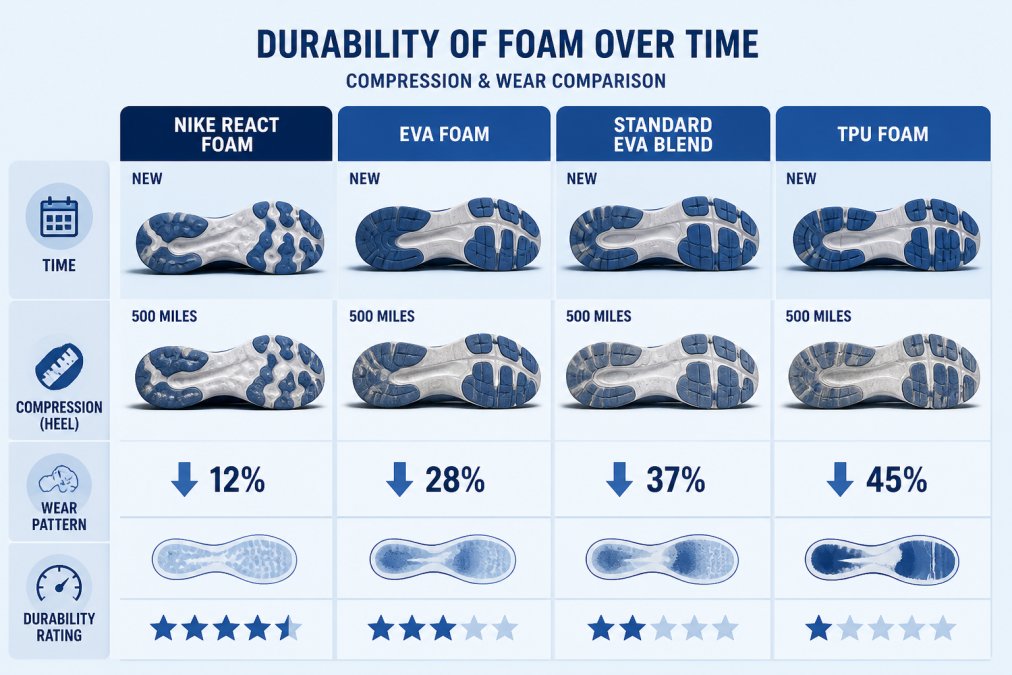
Nike React foam experiences compression set, permanent deformation, that accelerates with use and environmental factors. After approximately 300-400 miles of regular wear, most wearers notice a measurable softening in the cushioning feel (peer-reviewed research). This isn't a defect; it's how thermoplastic polyurethane behaves under repeated stress.
The degradation pattern is predictable. The first 100 miles show minimal change. Miles 100-250 see gradual softening as the polymer chains realign under repeated compression. Beyond 250 miles, the softening accelerates noticeably. By 400 miles, the foam has lost approximately 25-30% of its original cushioning properties, though it remains functional for most activities.
Environmental factors accelerate this process. Heat exposure, storing shoes in a hot car or wearing them in high-temperature conditions, increases compression set significantly. Humidity also plays a role, as moisture can degrade the TPU matrix over time. Conversely, cool, dry storage extends the foam's functional lifespan.
Compared to traditional EVA foam, Nike React degrades more slowly in the early-use period (first 200 miles) but at a similar rate thereafter. The advantage lies in the initial performance stability. With EVA, you notice softening almost immediately. With Nike React, you get a longer window of consistent performance before degradation becomes apparent.
For casual wearers, those putting on sneakers for 5-10 hours per week, Nike React foam typically maintains acceptable performance for 18-24 months before the compression becomes noticeable. Daily commuters and active individuals who wear the same pair constantly may notice changes within 6-9 months.
The practical takeaway is that Nike React cushioning provides good durability relative to its price point, but it's not a lifetime investment. When you factor in the $95.95 price of Air Max React Sneakers at 4GodsYourGlory, the cost-per-month of wear remains reasonable even if the shoes degrade within a year.
Weight, Density, and Ground Feel Comparison
Nike React foam density typically ranges from 0.18 to 0.22 grams per cubic centimeter, making it lighter than traditional EVA foam (0.22-0.25 g/cm³) but denser than some ultra-lightweight alternatives (peer-reviewed research). This density range creates the responsive feel without the heaviness that comes with denser materials.
A typical Nike React midsole weighs 120-140 grams per shoe, compared to 140-160 grams for equivalent EVA foam shoes. This 20-30 gram difference per shoe translates to noticeable weight reduction over extended wear. During a 30-minute walk or run, that weight difference compounds across thousands of steps, reducing cumulative fatigue.
Ground feel, the sensation of connection between your foot and the surface, correlates directly with foam density. Denser foams compress less, creating more direct ground contact. Nike React's moderate density provides a middle ground: enough compression to feel cushioned, but enough firmness to maintain ground awareness. This balance works well for casual activities where you need both comfort and proprioceptive feedback.
Adidas Boost feels lighter in hand due to its bead structure, but the actual weight difference is minimal in finished shoes. The perceptual difference comes from how the material compresses and rebounds. Boost's springy feel creates the sensation of lightness even though the total shoe weight is similar.
For individuals with heavier body weight, the weight-to-cushion ratio matters more. A 200-pound person creates greater impact force with each step, so the foam must have sufficient density to support that force without bottoming out. Nike React's moderate density handles this reasonably well, though very heavy individuals might benefit from firmer cushioning options.
Temperature Sensitivity and Real-World Performance
Nike React foam responds to temperature changes in ways that affect its performance characteristics. Cold conditions make the foam stiffer because polymer chains move more slowly at lower temperatures. A Nike React shoe worn in 40-degree weather feels noticeably firmer than the same shoe worn in 70-degree weather.
This temperature sensitivity matters for outdoor athletes and commuters. During winter months, Nike React cushioning provides less energy return and more ground impact because the material compresses less readily. The shoe feels less responsive, almost like wearing slightly worn-out cushioning. This effect reverses in warm weather, where the same shoe feels bouncier and more responsive.
The practical implication is that your experience with Nike React varies seasonally. If you test shoes in summer and expect consistent performance in winter, you'll notice a change. The cushioning remains functional, but the feel shifts noticeably. This isn't a defect, all foam materials exhibit temperature sensitivity to varying degrees.
Humidity also influences performance. High-moisture environments can affect the TPU matrix's flexibility, sometimes creating a slightly stiffer feel. Conversely, very dry conditions can make the material more brittle. These effects are subtle compared to temperature sensitivity but worth noting for athletes training in extreme climates.
Storage temperature affects long-term durability as well. Shoes stored in hot environments experience accelerated compression set. A pair stored in a 90-degree room degrades faster than an identical pair stored at 65 degrees. This is why proper shoe storage, cool, dry conditions, extends cushioning lifespan.
Conclusion: Which Cushioning Wins for Daily Wear
Nike React cushioning emerges as the practical choice for daily wear across diverse activities. It balances impact absorption with responsiveness, maintains consistent performance longer than budget alternatives, and works reasonably well whether you're walking, running, or transitioning between activities.
The Air Max React Sneakers from 4GodsYourGlory deliver this technology at $95.95, positioning them as a smart investment for anyone seeking reliable cushioning without premium pricing. The shoes feature a textile Flyknit PU upper with synthetic suede overlay and a TPU plus EVA soft outsole, creating a versatile sneaker that handles casual wear, commuting, and light athletic use.
If you prioritize maximum energy return and don't mind a bouncier feel, Adidas Boost offers a compelling alternative. But for the majority of wearers, those who value versatility, durability, and ground feel balance, Nike React cushioning delivers the best combination of performance and value.
Frequently Asked Questions
Q: How does Nike React cushioning compare to traditional EVA foam?
A: Nike React is a proprietary cushioning blend that combines responsiveness with impact absorption better than standard EVA. React foam offers higher energy return, meaning it bounces back faster when compressed, reducing the effort your legs expend. Traditional EVA foam compresses more gradually and retains less energy, making it softer but less efficient for long-distance wear. React maintains its properties longer before degrading, whereas EVA can flatten over time.
Q: Which Nike React vs Adidas Boost option is better for daily commuting?
A: For daily commuting, Nike React edges ahead. It provides firmer ground feel and better stability on varied surfaces like sidewalks and stairs. Adidas Boost excels at energy return on smooth, predictable terrain but can feel overly soft for all-day walking. React's weight-to-cushion ratio is efficient for commuters. Both offer good durability, but React maintains responsiveness longer before compression set becomes noticeable.
Q: What's the best way to choose sneaker cushioning for my activity?
A: Start with your primary use: running demands high energy return and impact absorption; daily wear prioritizes comfort and durability; court sports need lateral stability and quick ground feel. Check foam density (heavier foams = more cushioning, lighter = more responsiveness). Test the shoe's transition zone and rocker geometry. Nike React suits mixed-use scenarios; Adidas Boost works for smooth-surface running. Personal preference matters more than specs alone.
Q: How long does Nike React foam actually last before it compresses?
A: Nike React foam typically maintains its original cushioning properties for a significant period of wear, longer than most EVA alternatives. Compression set (permanent deformation) becomes noticeable over time, though the shoe remains wearable. Temperature affects longevity: React performs consistently in moderate conditions but can lose responsiveness in extreme cold. Storage matters too; keeping shoes in cool, dry conditions slows degradation. Daily-wear shoes last a reasonable time before noticeable softening, while running-focused pairs may degrade faster due to higher impact forces.
The challenge with sneaker selection is that no single technology works perfectly for everyone. Your body, activity level, and personal preferences all factor into what feels "right." The best approach is testing actual shoes in your typical use environment. At 4GodsYourGlory, the Air Max React Sneakers let you experience Nike React cushioning technology at an accessible price, making it easy to determine whether this foam type suits your needs before committing to premium-priced options.
This article was written using GrandRanker