
Table of Contents
- Why Replica Sneakers Show Manufacturing Flaws
- 1. Material Defects and Quality Issues
- 2. Stitching and Seam Irregularities
- 3. Sole Adhesion, Degumming, and Excess Glue
- 4. Color, Finish, and Sizing Inconsistencies
- 5. Abrasion Marks and Metal Hazards
- How to Spot Fake Sneakers: A Step-by-Step Inspection
- Common Shoe Manufacturing Defects: What Authentic Pairs Also Show
- Frequently Asked Questions
Last Updated: September 14, 2026
Why Replica Sneakers Show Manufacturing Flaws
The common signs of replica sneaker manufacturing flaws are the physical defects that appear when a factory prioritizes speed and cost over precision, and they show up in predictable places on almost every pair. This guide breaks down the most common signs, from material defects to metal hazards, so you can inspect any pair with confidence.
The core issue is simple: legitimate footwear brands enforce strict production standards at every stage of footwear assembly. Replica operations cut corners to hit volume targets, and those shortcuts leave traces. A common mistake is judging a shoe by its overall look instead of its construction details. The flaws are almost always in the finishing, not the silhouette.
Below, we'll show you how to spot fake sneakers using inspection criteria.
1. Material Defects and Quality Issues
The most reliable early signal is material quality, but the useful question is not 'does this feel cheap?' It is 'does this material fail the way a legitimate production run would have caught?' Replica uppers commonly substitute split-grain leather with a sprayed-on finish, polyurethane-coated fabric for full-grain leather, and low-denier mesh for engineered mesh (astm.org). Each substitution leaves a specific, repeatable trace.
Start with the upper. On genuine leather, press your thumbnail into the surface and watch the grain. Real grain compresses and springs back with a fine, irregular pattern. A sprayed finish on split leather stays smooth, then shows a faint crescent or a lighter patch where the coating lifted. On engineered mesh, look at the weave under a phone light: authentic mesh has a tight, uniform knit with reinforced zones at the toe and midfoot; replica mesh often has a looser, shinier weave that puckers at the panel edges.
Next, check the lining and collar. Non-woven fabric lining that pills, feels papery, or separates from the upper at the collar is a classic factory flaw, not normal break-in. On authentic pairs, the lining is usually a knit or textile with a bonded edge that stays put through flexing. On replicas, the lining is often glued rather than stitched, so it lifts at the heel and tongue first.
Then check the midsole and insole. Replica midsoles frequently use a lower-density EVA or a blended foam that compresses unevenly. Press the midsole along its length: authentic foam returns to shape at the same rate across the shoe; replica foam often stays compressed at the heel and feels firmer at the forefoot. Pull the insole if it is removable. A genuine insole has a molded heel cup and a consistent thickness; a replica insole is often a flat die-cut sheet with a printed logo that smears under a wet thumb.
Finally, check the small parts. Lace tips (aglets) on authentic pairs are metal or a hard, matte plastic that does not deform. Replica aglets are often soft plastic that bends or splits. Tongue labels should be woven, not printed on satin, and the lettering should stay crisp when you rub it. A printed label that smears is a material defect, not a cosmetic one.
A quick field test: flex the toe box with both thumbs. Authentic leather and engineered mesh crease in fine, parallel lines that recover. Replica materials crease in one sharp fold and stay creased, or show a white stress line where the coating has cracked.
The retail-vs-replica distinction matters here. Legitimate brands do ship occasional material variation between batches, but those pairs are filtered by incoming inspection. Replica batches skip that filter, so the same defect that would be a one-off on a legitimate line becomes the norm on a replica run.
2. Stitching and Seam Irregularities
Stitch work is where replica flaws become obvious at close range. Genuine pairs hold consistent stitch counts per inch, straight lines, and clean seam integrity. Replicas show wandering stitch rows, uneven spacing, loose threads, and skipped stitches that leave gaps in the seam.
Inspect these areas specifically:
- Toe box stitching: should be tight and symmetrical on both shoes
- Heel tab and collar seams: watch for puckering or overlapping panels
- Tongue embroidery: lettering should be crisp, centered, and evenly stitched
- Eyelet alignment: eyelets should sit level and mirror each other
A useful benchmark for seam quality comes from ASTM International footwear standards, which outline how stitched seams should perform under stress. Replica seams frequently fail that standard because the assembly line skips reinforcement stitching.
3. Sole Adhesion, Degumming, and Excess Glue
Sole problems are the most common complaint on replica pairs. Degumming, where the outsole separates from the midsole, happens when cementing is rushed or the wrong adhesive is used. You'll see it first at the toe and heel edges, where the sole starts lifting away from the upper.
Excess glue is the other giveaway. Overflowing glue along the midsole seam, hardened yellow residue at the toe cap, and glue stains on the upper all point to sloppy finishing. Run a fingernail along the sole seam. If you feel ridges of dried adhesive or see a visible gap, the bond is already compromised.
Press the sole edge firmly with your thumb at three points: the toe, the midfoot, and the heel. A well-cemented sole stays flush. If you see the seam open slightly and spring back, the adhesive bond is weak and will fail with regular wear.
4. Color, Finish, and Sizing Inconsistencies
Color, finish, and sizing problems are the flaws buyers most often dismiss as 'just how it looks.' They are also the ones that most reliably separate a replica batch from a legitimate production run, because they trace back to dye lots, material batches, and the last used to build the shoe.
Start with color. Compare the left and right shoe side by side under daylight, not indoor lighting. Indoor bulbs shift blues and reds and hide the yellow-green cast that shows up on replica midsoles. Look at three zones: the side panels, the midsole, and the heel counter. On authentic pairs, those zones match because they come from the same dye lot. On replicas, panels are often cut from different lots, so one shoe reads slightly warmer or cooler than the other. A common pattern is a white midsole with a faint yellow or gray tint that becomes obvious next to a true-white lace or sock.
Finish is the next check. Run your finger along the edge of a leather panel. Authentic edges are burnished or painted with a consistent sealant; replica edges are often raw, fuzzy, or coated with a sealant that has already cracked. On suede, brush the nap with your thumb. Authentic suede has a dense, even nap that moves in one direction; replica suede has a thin, patchy nap that exposes the backing. On patent or glossy finishes, look for orange-peel texture and swirl marks under a phone light.
Sizing is where the last matters. A replica 'size 10' can run a half size short or wide because the factory used a last that does not match the original spec. Measure three things: insole length from heel to toe, insole width at the ball of the foot, and heel-to-toe drop. Compare those numbers against a pair you already own in the same size. A difference of more than about a quarter inch in length or an eighth inch in width is a sizing drift, not a break-in issue. Also check the insole print: authentic insoles have a size stamp that matches the box label; replica insoles often have a mismatched or missing stamp.
| Flaw Type | Where to Check | What It Signals |
|---|---|---|
| Discoloration | Side panels, midsole | Inconsistent dye lots |
| Finish variation | Leather grain, suede | Mixed material batches |
| Sizing drift | Insole length, toe box | Incorrect last used |
| Bleeding dye | White midsoles, laces | Poor colorfast treatment |
| Mismatched stamp | Insole print, box label | Unfiltered batch output |
Legitimate brands do ship minor color variation between batches, and that is normal. The difference is that a legitimate pair will match itself, left to right, because both shoes come from the same run. When the mismatch is between the two shoes in the same box, that is a replica marker, not a factory tolerance.
5. Abrasion Marks and Metal Hazards
Abrasion marks and sharp points are the safety issues most buyers overlook. Replica pairs frequently ship with scuffs, scratches, and surface scars from careless handling during batch production. Some are cosmetic; others expose raw material underneath.
The bigger concern is metal. Loose eyelets, protruding rivets, and unfinished shank ends can scratch floors or catch on socks. Run a finger inside the shoe along the eyelet row and around the heel counter. Any sharp point you can feel is a manufacturing defect, not a break-in issue.
How to Spot Fake Sneakers: A Step-by-Step Inspection
Learning how to spot fake sneakers comes down to a repeatable inspection routine. Work through these seven checks in order, ideally under bright daylight, and you'll catch the majority of common signs of replica sneaker manufacturing flaws in under ten minutes.
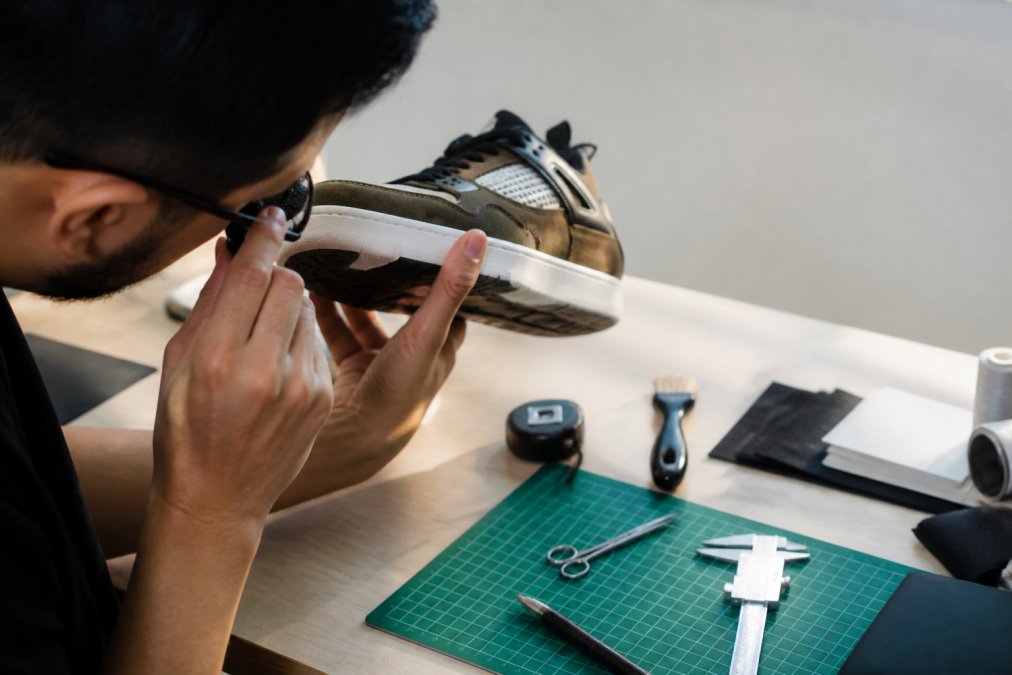
- Smell the shoe. Strong chemical or solvent odor suggests low-grade adhesives and dyes.
- Check the stitching. Look for uneven spacing, loose threads, and skipped stitches.
- Flex the sole seam. Press the toe and heel edges to test the adhesive bond.
- Inspect for glue stains. Look for overflow at the midsole and toe cap.
- Compare both shoes. Color, panel shape, and height should match exactly.
- Measure the insole. Verify length and width against a known pair.
- Feel for sharp points. Run a finger along eyelets, rivets, and the heel counter.
The U.S. Consumer Product Safety Commission tracks footwear hazards and recalls, and sharp points and loose hardware are recurring categories. If a pair fails step seven, treat it as a return, not a wear-in.
Common Shoe Manufacturing Defects: What Authentic Pairs Also Show
Common shoe manufacturing defects appear in authentic pairs too, which is why context matters more than a single flaw. Even major brands ship pairs with minor creasing, slight color variation between batches, or a stray thread. The difference is frequency and severity.
This is where the batch context becomes useful. Authentic production runs have documented quality control tolerances, and defects above those thresholds get pulled before retail. Replica batches skip that filtering step, so flaws that would be rejected on a legitimate line reach the buyer instead.
One minor flaw does not prove a shoe is fake. A cluster of flaws across materials, stitching, adhesive, and finishing does. Judge the pattern, not the single defect.
Spotting replica flaws takes practice, but the payoff is real: fewer returns, better-fitting shoes, and no surprises after checkout. If you'd rather skip the guesswork entirely, 4GodsYourGlory offers a curated selection of Air Max React Sneakers built with cushioned EVA outsoles and breathable mesh uppers, plus practical everyday essentials like automotive sun shades and casual headwear. Every pair is backed by a straightforward online shopping experience designed for people who want reliable footwear without the inspection anxiety. Browse the 4GodsYourGlory catalog and find your next pair.

Frequently Asked Questions
How to tell if shoes are replicas?
Check the stitching first: authentic pairs have tight, even seams with consistent spacing. Replica sneaker flaws include crooked stitching, loose threads, and uneven seam integrity. Next, inspect the sole for excess glue or degumming, and look at the toe box for creasing or misalignment. A genuine pair will also have clean eyelet alignment and a crisp insole print. If multiple details look off, the pair is likely a replica.
What are the most common manufacturing defects in sneakers?
Common shoe manufacturing defects include material defects like scars or holes in the upper, stitching irregularities, sole adhesion failure (degumming), overflowing glue stains, color and finish inconsistencies, sizing discrepancies, abrasion marks, and metal or sharp point hazards. These flaws appear in both authentic and replica pairs, but replicas tend to show them more frequently and more severely due to lower production standards and rushed footwear assembly.
Do authentic sneakers ever have manufacturing flaws?
Yes. Even authentic sneakers from major brands can have minor flaws such as slight glue stains, small creases, or minor stitching irregularities. The difference is frequency and severity. Authentic pairs go through stricter quality control and inspection criteria, so defects are less common. Replica sneaker flaws are typically more obvious, appear across multiple areas, and often include structural issues like adhesive failure or misaligned eyelets.
Are replicas produced in the same factories as authentic shoes?
No. Replicas are not produced in the same factories as authentic shoes. While some replica makers may use similar materials or copy designs, they operate in separate facilities with different production standards and quality control processes. This is why replica sneaker flaws are more prevalent. The batch production context matters too: even within replica batches, quality varies, so two pairs of the same model can have different defects.