
Table of Contents
- What You'll Need to Measure Foot Width at Home
- How to Measure Foot Width: Step-by-Step Instructions
- How to Measure Shoe Size at Home for a Complete Fit
- Shoe Width Chart for Men and Women: Reading the Letters
- What Does Wide Width Mean in Shoes?
- Tips for Accurate Measurement and Common Mistakes to Avoid
- Frequently Asked Questions
Last Updated: September 18, 2026
What You'll Need to Measure Foot Width at Home
Learning how to measure foot width at home 2026 starts with four simple tools. This guide from 4GodsYourGlory walks you through each step so you can order footwear online with confidence.
Getting the right fit comes down to preparation. Most people blame their shoes when the real problem is a rushed measurement.
Here is what to gather before you start:
- A blank sheet of paper, larger than your foot
- A pen or pencil
- A tape measure or ruler
- A chair to sit on
If you have a Brannock device at home, it can help confirm your numbers. But paper works just as well when you follow the steps below.
According to the American Podiatric Medical Association, proper measurement is the foundation of foot health. Take five extra minutes now, and you avoid weeks of returns later.
How to Measure Foot Width: Step-by-Step Instructions
Measuring foot width takes about five minutes per foot. Follow these three steps in order, and write down every number.
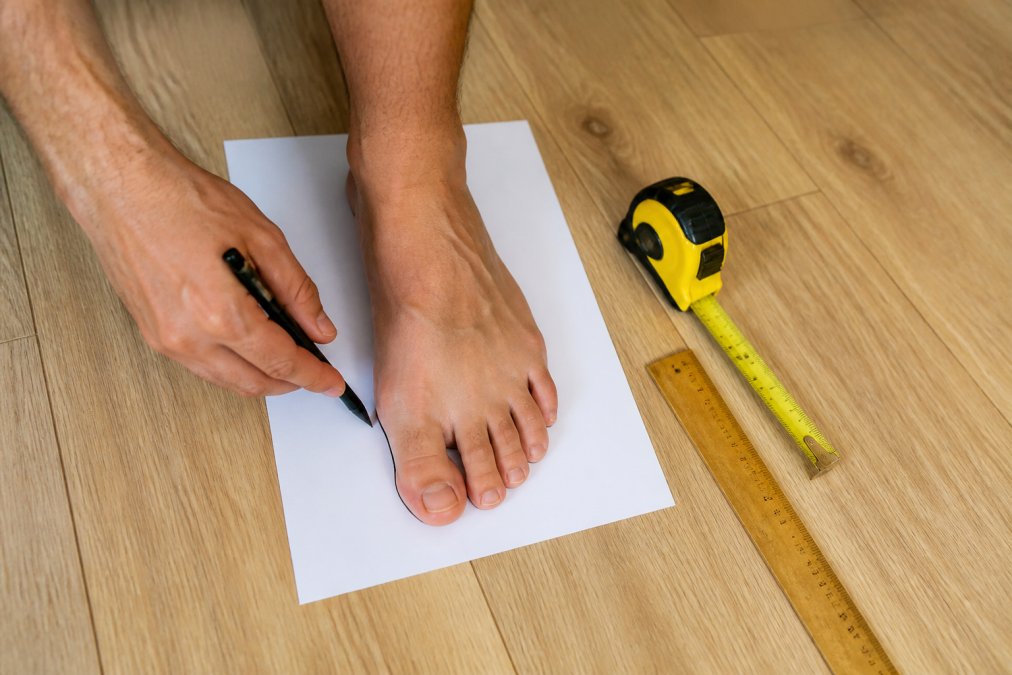
Step 1: Trace Your Foot
Place the paper on a hard floor, not carpet. Stand with your full weight on the paper so your foot spreads naturally.
Hold the pen straight up and down. Trace the outline of your foot, keeping the pen against your skin the whole way.
A common mistake is tracing while seated. That gives you a smaller outline than your foot actually is when you walk.
Step 2: Measure the Widest Point (Ball of the Foot)
The ball of the foot is the widest point, just behind your toes. This is where width matters most, and it is also the step most people get wrong, because the ball is not a single obvious line. It is a zone.
Find the ball of your foot by feel, not by eye. Run your thumb along the inside edge of your foot until you feel the first long bone that angles up toward your ankle. That joint, the first metatarsophalangeal joint, marks the inner edge of the ball. On the outside edge, find the matching joint at the base of your smallest toe. The straight line between those two points is your ball width.
If your feet are not typical, adjust the method:
- Bunions (hallux valgus): the bony bump at the base of the big toe pushes the true ball width outward. Measure across the widest part of the bump, not the joint underneath it, or your shoe will pinch.
- Tailor's bunion (bunionette): the same problem on the pinky-toe side. Measure to the outer edge of the bump.
- High arches: the ball may look narrow while the instep is tight. Measure the ball normally, but note that you may need a wider width to clear the instep.
- Flat feet: the foot spreads under load, so a standing trace can read a half-width wider than a seated one. Trust the standing number.
- Very wide forefoot with narrow heel: measure the ball for width and the heel separately. Some brands offer combination lasts for exactly this shape.
Step 3: Measure Heel-to-Toe Length
Measure from the very back of your heel to the tip of your longest toe. Use the same tracing you already made.
How to Measure Shoe Size at Home for a Complete Fit
Width alone does not tell the whole story. You also need length to match a standard sizing chart.
Shoe Width Chart for Men and Women: Reading the Letters
Shoe width letters look confusing at first, but the system is simple. Each letter marks a step up or down from medium.
| Width | Women's | Men's | What It Means |
|---|---|---|---|
| Narrow | AA | B | Slimmer than average |
| Medium | B | D | Standard fit |
| Wide | D | 2E | More room across the ball |
| Extra Wide | EE | 4E | Maximum room |
What Does Wide Width Mean in Shoes?
Wide width means extra room across the ball of the foot. It does not mean the shoe is longer.
Here is when to size up to a wide:
- Your current shoes pinch across the ball
- The sides of your feet bulge over the footbed
- You feel pressure near your smallest toes
- Your arch support feels shifted off-center
Tips for Accurate Measurement and Common Mistakes to Avoid
Small errors add up fast. A few habits will keep your numbers reliable.
- Measure at the end of the day, when feet are largest
- Wear the socks you plan to wear with the shoes
- Stand, do not sit, while tracing
- Keep the pen vertical, never angled
- Measure both feet and use the larger number
- Recheck your millimeter conversion twice
- Measure on a hard surface, not carpet
The Afternoon Rule: Why Time of Day Changes Your Width
Foot volume rises through the day. Gravity pulls fluid into the feet while you stand and walk, and the soft tissues around the arch and ball relax under repeated load. Most practitioners find the difference between a first-thing-in-the-morning measurement and a late-afternoon one can reach roughly half a width, sometimes a full width for people who are on their feet all day or who have swelling related to circulation, pregnancy, or warm weather.
Width Needs Change by Shoe Type
A single width number does not translate cleanly across every shoe in your closet. The last (the foot-shaped form a shoe is built on) differs by category, so the same foot can be a medium in one style and a wide in another.
- Running and athletic shoes: built on a wider, more anatomical last with a roomier toe box. Many runners can wear their measured width or even a half-width narrower than their dress-shoe size, because the upper stretches and the lacing can be adjusted. If you run long distances, add a thumb's width of space in front of the longest toe to allow for forward slide and swelling.
- Dress shoes and loafers: built on a narrower, tapered last with less give in the leather or synthetic upper. Size to your measured width or one wider, especially if you have a high instep. Loafers have no laces to loosen, so width errors show up immediately.
- Boots and work shoes: often run wide in the heel and narrow in the forefoot. Measure your ball width carefully and check the heel separately; a boot that fits the ball may still slip at the heel.
- Sandals and open-toe styles: width matters less because there is no upper to pinch, but the footbed still needs to match your arch length. A footbed that is too narrow will let your arch hang over the edge.
- Cleats and cycling shoes: these run notoriously narrow. Most people need to size up a half to full width compared to their everyday shoes.
Other Mistakes That Skew Your Numbers
- Measuring one foot only. Your dominant foot is often slightly larger. Size to the larger foot every time.
- Measuring over thick socks you will not wear with the shoe. Sock thickness can add a noticeable amount to your ball width.
- Trusting an old measurement. Feet change with age, weight, pregnancy, and activity. Remeasure every year or two, and any time your shoes start to feel different.
- Rounding down. If your ball width lands between two width letters, go up, not down.
For more detail on foot care and measurement, the Mayo Clinic overview of foot health is a solid reference.
Frequently Asked Questions
How can I measure my foot width at home?
Stand on a piece of paper and trace the outline of your foot. Use a tape measure or ruler to measure the widest part, which is the ball of the foot. Record the measurement in inches or millimeters. Then compare it to a shoe width chart to find your width designation. Always measure both feet and use the larger measurement for the best fit.
Is my foot width D or EE?
For men, a D width is medium, and EE is extra wide. For women, a D width is wide, and EE is extra wide. To determine your width, measure the ball of your foot and compare it to a standard shoe width chart. If your measurement falls between sizes, choose the wider width for comfort, especially if you have a high instep or wide forefoot.
How wide do your feet have to be to be considered wide?
Foot width is relative to length. Foot width is relative to length. Always refer to a specific brand's sizing guide because standards vary. Measuring your foot and using a shoe width chart is the most accurate way to determine if you need a wide width.
Does foot width change as you age?
Yes, foot width can increase with age due to factors like weight gain, arthritis, or gradual spreading of the ligaments. It's wise to remeasure your feet every year or two, especially before buying new shoes. If you notice your current shoes feel tight in the width, it may be time to go up a width size or try a different style with a wider toe box.
Getting the fit right solves the biggest problem with buying footwear online: the guesswork. At 4GodsYourGlory, we built our store around that idea, with a wide selection of Air Max React Sneakers and a convenient shopping experience that makes finding your size simple. Use our sizing guide, measure both feet, and order with confidence. Get started with 4GodsYourGlory and find footwear that fits the first time.