
Table of Contents
- Why Getting Correct Shoe Sizing Right Matters
- How to Measure Shoe Size at Home
- Signs Your Shoes Don't Fit Properly
- The Best Time of Day to Buy Shoes
- Evaluating Shoe Shape, Width, and Volume
- Testing Fit in the Store and Online
- Conclusion: Building a Consistent Sizing Routine
- Frequently Asked Questions
Last Updated: September 12, 2026
Why Getting Correct Shoe Sizing Right Matters
Getting correct shoe sizing right is the foundation of foot comfort, and it's the step most online shoppers rush. This guide from 4GodsYourGlory walks through the measurement methods, timing tricks, and fit tests that separate a shoe you wear daily from one that sits in the closet.
Nail it, and you avoid blisters, calluses, and the return cycle. Miss it, and you're stuck with pressure points that show up a week later.
The Hidden Costs of Wrong Sizing
Wrong sizing costs more than a return label. A shoe that's too narrow compresses the metatarsal area and midfoot; too short, and your toes jam against the toe box on every stride. Over time, that friction produces calluses and blisters that no break-in period fixes.
The bigger hidden cost is consistency. Many shoppers assume their size never changes, so they order the same number for a decade. Foot anatomy shifts with age, weight, and activity, and size variance between brands can run a half size or more. A running shoe last is not a casual sneaker last.
How to Measure Shoe Size at Home
Measuring shoe size at home takes about ten minutes, a wall, a sheet of paper, a ruler, and a pencil. Do it late in the day, when feet are largest, and measure both feet every time, most people have one foot a half size larger than the other (apma.org).
- Stand with your heel against the wall on the paper, wearing the socks you'll wear with the shoe.
- Mark the tip of your longest toe, not your big toe, your longest toe.
- Measure heel to mark in millimeters for both feet.
- Measure width across the widest part of the forefoot, usually at the metatarsal heads.
- Compare against the specific brand's size chart, not a generic one.
- Repeat in the evening for a second reading and use the larger number.
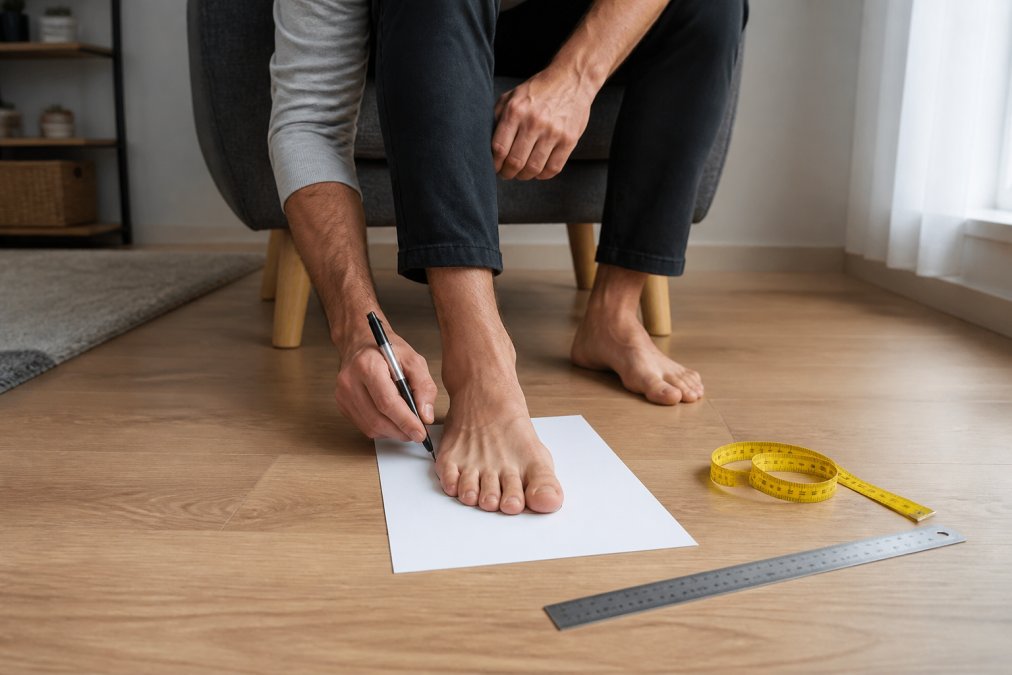
Using a Brannock Device vs. Tracing Your Foot
A Brannock device measures length, width, and arch length in one pass, which is why shoe stores still use it. Tracing captures length and width but misses arch position, so it can't tell you whether you need a wider width sizing or just a longer shoe.
For online orders, combine both: trace at home, then cross-check the brand's chart. The American Podiatric Medical Association's foot health guidance notes that measuring both feet matters because most people have one foot noticeably larger. If your arch length is longer than your foot length, you may need a half size up even when the length measurement says otherwise.
Converting Your Measurement to a Size
Once you have millimeters, convert before you shop. The table below uses standard men's and women's conversions; kids' sizes run on a separate scale and should always be checked against the brand's own chart.
| Foot Length (in) | Foot Length (mm) | Men's | Women's |
|---|---|---|---|
| 9.25 | 235 | 6 | 7.5 |
| 9.5 | 241 | 6.5 | 8 |
| 9.75 | 248 | 7 | 8.5 |
| 10 | 254 | 8 | 9.5 |
| 10.25 | 260 | 8.5 | 10 |
| 10.5 | 267 | 9 | 10.5 |
| 10.75 | 273 | 9.5 | 11 |
| 11 | 279 | 10.5 | 12 |
Two cautions. First, this is a starting point, not a guarantee, lasts vary by brand and model, and a running shoe last is not a casual sneaker last. Second, width is a separate axis: a D width in one brand can fit like an E in another, so always check the model's width chart alongside the length chart.
When Swelling or a Medical Condition Changes the Math
Most sizing guides ignore the fact that feet change size for reasons beyond time of day. A common pattern is that people with diabetes, edema, or who are pregnant need to size up or choose a wider width, because swelling and fluid retention can add a half size or more across the day (PubMed). Neuropathy can also mask the feedback that tells you a shoe is too tight, which makes measurement more important, not less.
If any of those apply, measure in the evening, measure both feet, and lean toward the larger measurement. A removable insole gives you a way to reclaim volume on low-swelling days without buying a second pair.
Signs Your Shoes Don't Fit Properly
Signs your shoes don't fit properly show up fast if you know what to look for. Heel slippage, pinched toes, and hot spots along the heel counter are the first three.
- Toes touch the front of the toe box when standing
- Heel lifts more than a finger's width when walking
- Pressure points along the midfoot or arch
- Blisters forming after short walks
- The upper material creases sharply across the forefoot
If two or more apply, the size or width is wrong, not the shoe.
When to Trust the Thumb's Width Rule
The thumb's width rule says you should have roughly a thumb's width, about 1 to 1.5 centimeters, between your longest toe and the front of the shoe. It's a decent starting point, but it assumes a standard last and ignores width.
Trust it for length checks only. For width, volume, and arch support, you need a proper fit test.
The Best Time of Day to Buy Shoes
The best time of day to buy shoes is late afternoon or evening, when foot swelling peaks. Feet expand through the day from standing, walking, and heat, and a shoe that fits at 8 a.m. can feel tight by 6 p.m.
Shop after work, after a walk, or after any activity that leaves your feet warm. If you're ordering online, measure at that same time of day so your numbers match your real-world fit.
Evaluating Shoe Shape, Width, and Volume
Shoe shape, width, and volume are three separate variables, and most shoppers only check one. Width sizing handles the forefoot; volume describes how much room sits above your instep.
Match the shape to your foot anatomy. A wide forefoot needs a roomier toe box; a high instep needs more volume; a narrow heel needs a snug heel counter for lateral stability.
| Fit Variable | What It Controls | Sign It's Wrong |
|---|---|---|
| Width sizing | Forefoot room | Pinching at the metatarsal area |
| Volume | Space above the instep | Pressure on top of the foot |
| Toe box shape | Toe spread and length | Toes jam or overlap |
| Heel counter | Rearfoot lockdown | Heel slippage on every step |
| Flex point | Where the shoe bends | Stiff, awkward stride |
Insole and footbed choices also shift fit. A thicker insole eats volume; a thinner one frees it.
Testing Fit in the Store and Online
Testing fit properly means trying on both shoes, not just one, and walking on a hard surface for at least a minute. Most people have one foot larger than the other, and you fit to the larger foot, never the smaller.
In the store:
- Walk on tile, not carpet, to feel the flex point
- Check heel slippage with a brisk walk
- Press the toe box to confirm toe room
- Test both shoes, laced as you'd wear them
- Bring the socks you'll actually wear with the shoe
Online, you're relying on measurement accuracy and return policy. A sizing calculator or gait analysis tool can help, but it can't replace trying the shoe on. Order from sellers with clear return terms, and check the model's fit notes before checkout.
Lacing Techniques That Fix Minor Fit Issues
Before you size up or down, try relacing. A few patterns solve problems that look like sizing problems:
- Heel lock (runner's loop): After the top eyelet, thread the lace back through the loop on the same side to create a small loop, then cross and tie. This pulls the heel into the heel counter and reduces slippage without tightening the forefoot.
- Window lacing: Skip the eyelets over a pressure point and run the lace straight up the sides. Useful for a high instep or a hot spot on top of the foot.
- Wide forefoot lacing: Use two sets of laces or skip the middle eyelets to relieve pressure across the metatarsal area.
- Narrow heel lacing: Tighten the top two eyelets more than the lower ones to lock the rearfoot while leaving the toe box roomy.
If a half-size-too-big shoe fits perfectly after a heel lock, you may not need a different size at all. If lacing doesn't fix it, the size or width is wrong.
Return Policies and the True Cost of Online Sizing
Online sizing only works if the return path is clean. Before you buy, check three things: the return window, whether return shipping is free, and whether the seller accepts worn shoes. A generous window matters because swelling and break-in change fit over the first week.
A practical approach is to order two sizes when the seller offers free returns, keep the one that fits after a full day of wear, and send the other back. That costs nothing extra when returns are free and eliminates the guesswork that drives most sizing returns.
When Swelling or a Medical Condition Changes the Test
If you have diabetes, edema, or are pregnant, the in-store test needs an adjustment. Try shoes on in the afternoon or evening, when swelling peaks, and walk for several minutes rather than one. Check for pressure points you can feel but not see, neuropathy can hide them. A shoe that feels snug at 10 a.m. may be painful by 6 p.m., so the evening fit is the one that matters.
Conclusion: Building a Consistent Sizing Routine
Sizing isn't a one-time task; it's a routine. Measure twice a year, re-measure after any major change in activity or weight, and log the sizes that actually fit you across brands. That log is worth more than any generic size chart.
At 4GodsYourGlory, we stock a wide selection of Air Max React Sneakers built for daily wear, alongside practical automotive accessories like sun shades and casual headwear. Our catalog is designed for people who want functional footwear and lifestyle essentials without the guesswork.
Start with a fresh measurement, check the fit notes on the model you want, and order with confidence. Browse the 4GodsYourGlory catalog and find the pair that fits the foot you actually have.
Frequently Asked Questions
How much space should be between your toe and the end of the shoe?
You should have about a thumb's width (roughly 1/2 inch) of space between your longest toe and the front of the shoe. This allows your foot to move naturally without hitting the toe box. If your toes touch the end, the shoe is too small and can cause blisters or calluses over time.
Do shoe sizes vary by brand?
Yes, shoe sizes can vary significantly between brands. A size 10 in one brand might fit like a 9.5 in another due to differences in last shape, width sizing, and volume. Always check the brand's specific size chart and read reviews about fit before ordering. When trying on shoes, trust the feel over the number on the box.
Should you measure your feet in the morning or evening?
Measure your feet in the evening or after a day of activity. Feet swell naturally throughout the day due to gravity and walking, so an evening measurement gives you the most accurate size for when your feet are at their largest. This helps ensure correct shoe sizing that won't feel tight later.
How do I know if my shoes are too narrow?
If you feel pressure on the sides of your feet, see bulging over the midsole, or experience numbness or tingling, your shoes are too narrow. The widest part of your foot should align with the widest part of the shoe without squeezing. Look for shoes with width sizing options or a wider toe box if you have a broader forefoot.